Island Peak Climbing with EBC Trek – 17 Days

171 Reviews in TripAdvisor
57 Reviews in Google

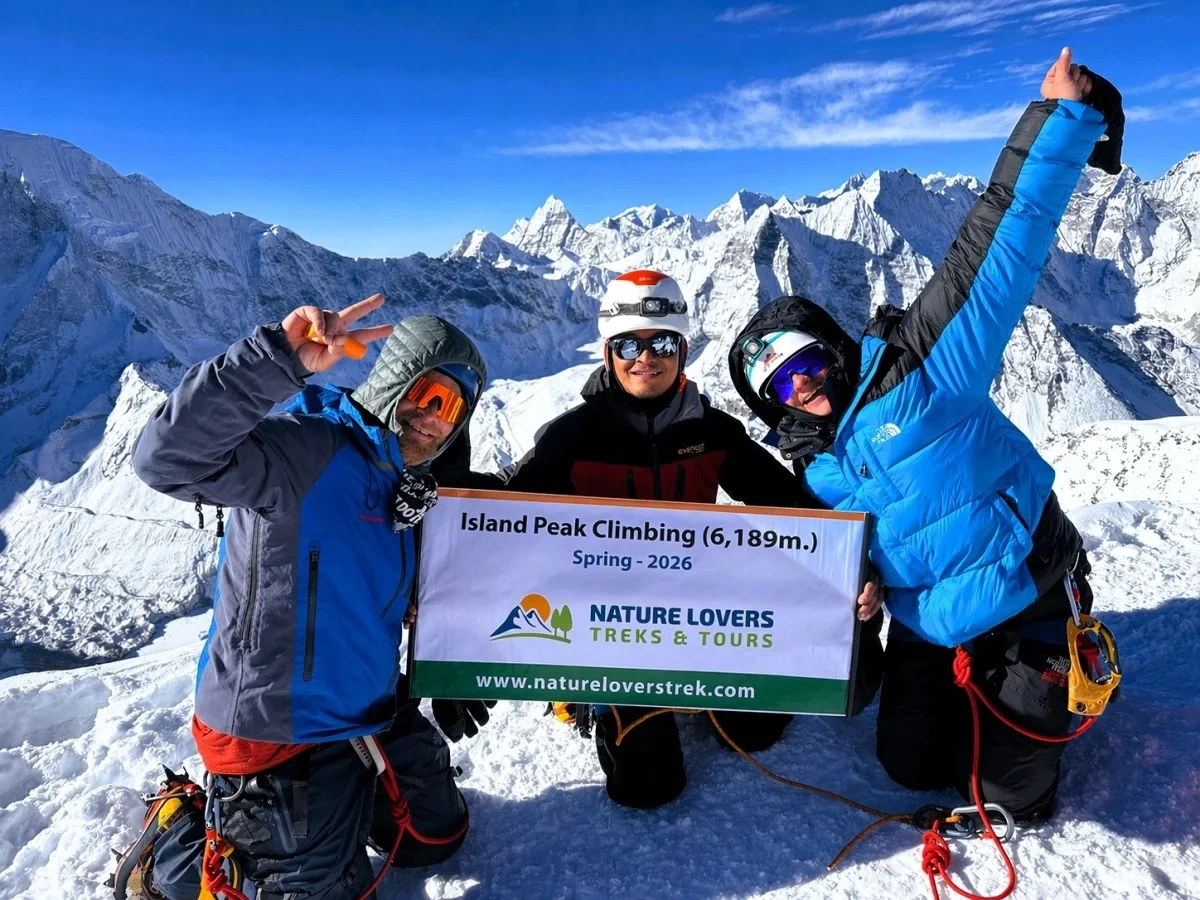
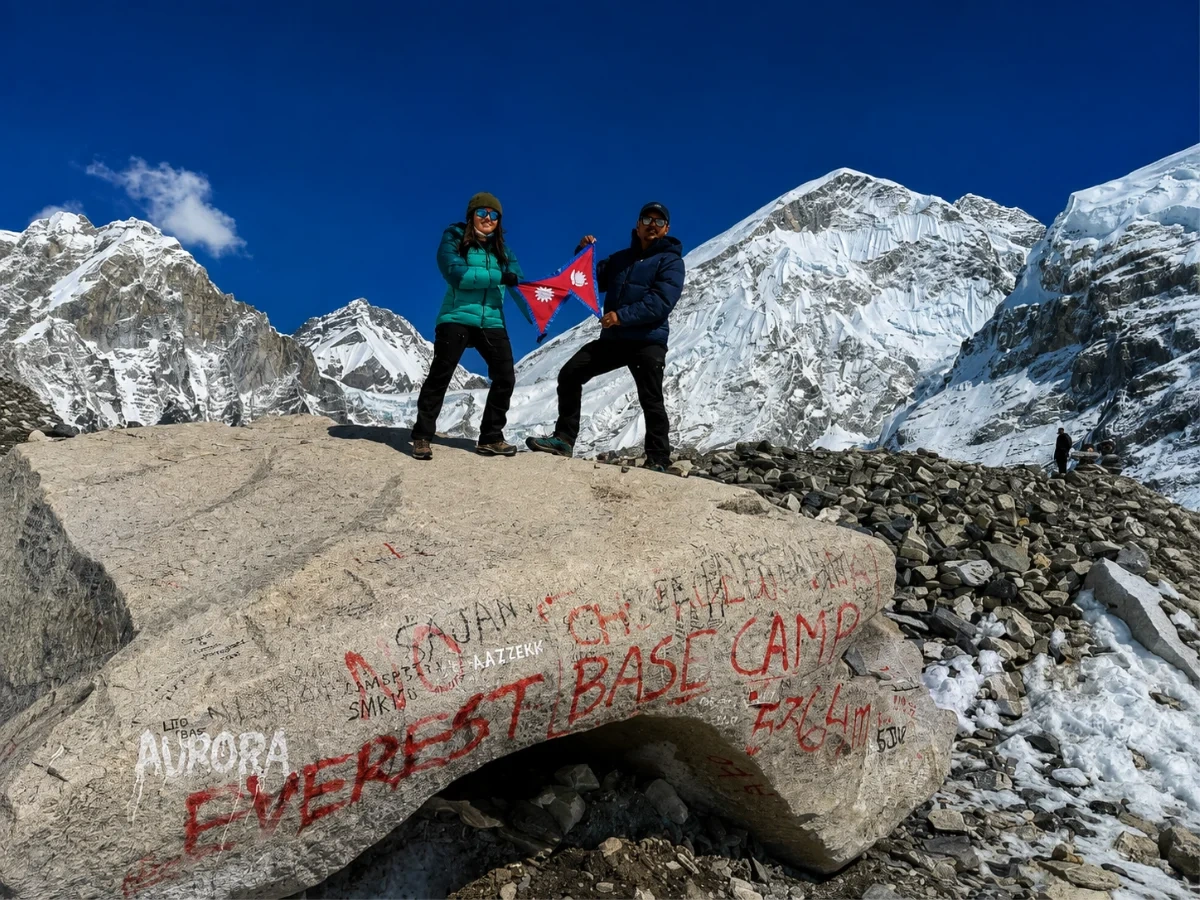
The 17-day Island Peak Climbing with EBC Trek combines the classic Everest Base Camp (5,364 m), Kala Patthar (5,545 m), and technical Island Peak Climbing (6,189 m) into one itinerary. The 17-day Island Peak summit is a challenging Himalayan adventure that includes acclimatization days in Namche and Pheriche. Trekkers will enjoy the breathtaking mountain views of the entire Everest region.

The Island Peak Climbing difficulty is graded as strenuous because the trail demands technical mountaineering skills to reach the summit. Trekkers who have completed the 14-day Everest Base Camp Trek without shortcuts or other moderate trekking destinations in Nepal can attempt the Island Peak summit. The real summit climb requires proper climbing tools and mountaineering skills to reach 6,189 m above sea level.

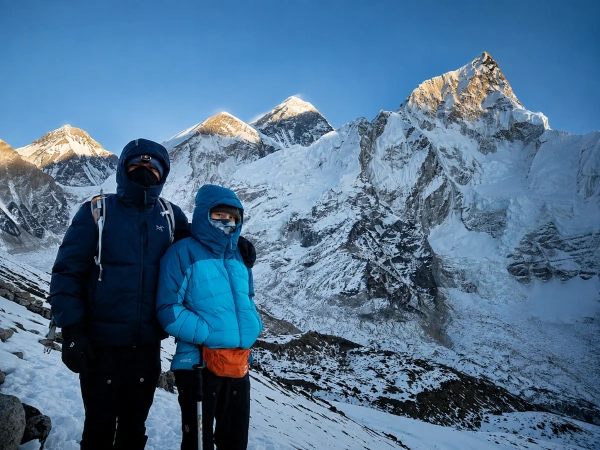
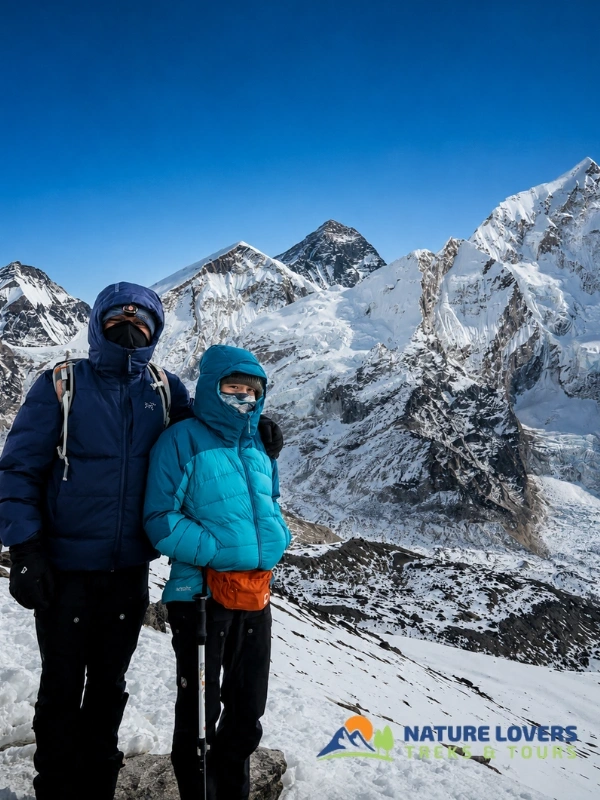
The Nature Lovers Treks and Tours team combined the two most popular Everest region trekking destinations in a single itinerary. The journey offers majestic views of the entire Khumbu Mountains from the Kala Patthar (5,545 m) and Island Peak summits (6,189 m) above sea level. Trekkers will walk a rewarding high-altitude route in Nepal, enjoying the majestic snow-capped mountain views, villages, religious sites, and rhododendron forests.

Key Takeaway: Climbing Island Peak Summit from Chhukung takes around 10-12 hours of walking on the steep upper headwall trails covered in snow. 

Duration
17 Days
Trip Grade
Strenuous
Country
Nepal
Max Altitude
6,189m / 20,305 ft. at Island Peak
Starts
Kathmandu/Ramechhap to Lukla
Ends
Lukla to Kathmandu/Ramechhap
Group Size
Private/Shared group
Activities
Trekking & Climbing
Best Time
Spring (March–May) & Autumn (September–November)

What is Island Peak Climbing with EBC Trek—17 Days?

The Island Peak Climbing with EBC Trek is a combined high-altitude adventure of Everest Base Camp and the Island Peak summit in a 17-day itinerary.

Overview of the Combined Trek and Climb

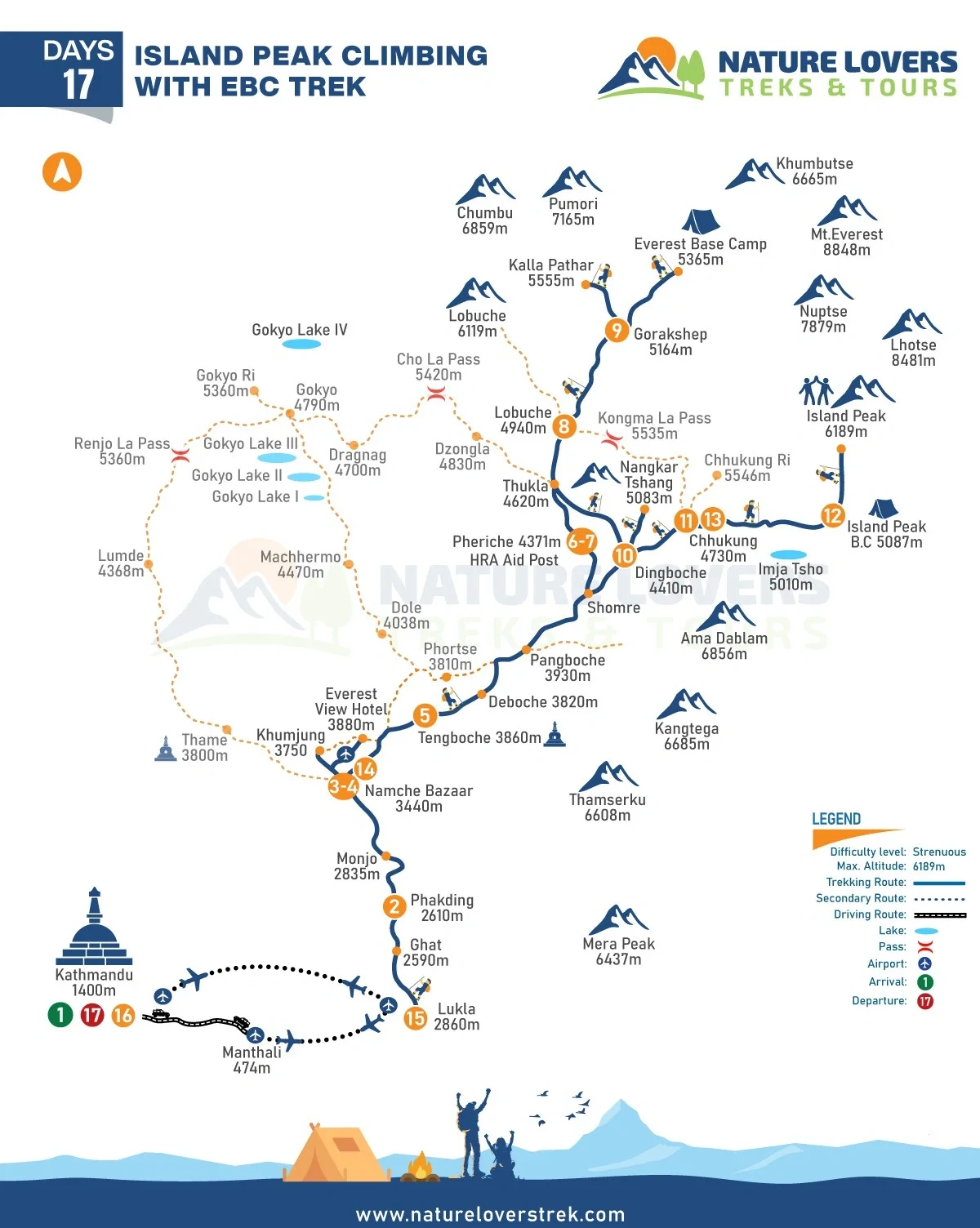
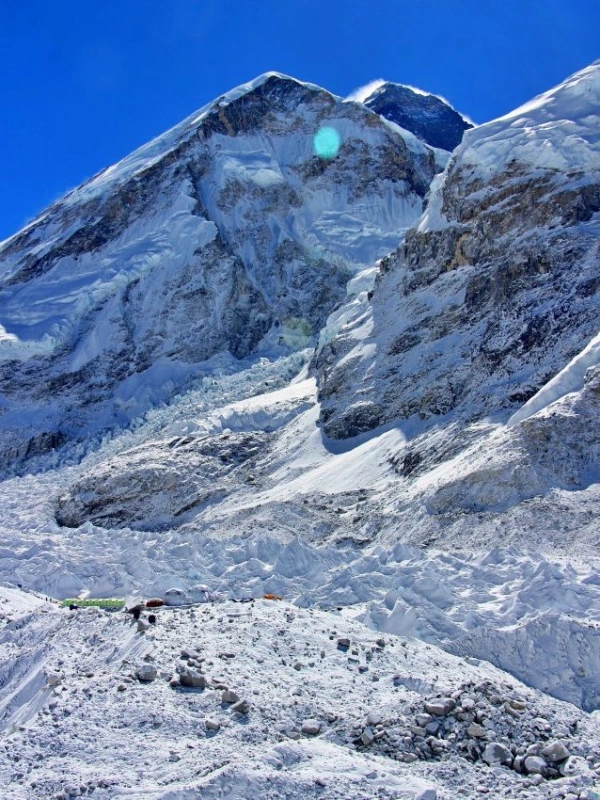
The journey is divided into two parts. The first part of the itinerary leads to Everest Base Camp (5,364 m) and Kala Patthar (5,545 m). Trekkers will walk through Phakding, Namche Bazaar, Tengboche, Pheriche, Lobuche, Gorak Shep, Everest Base Camp, and Kala Patthar. The second half of the adventure requires mountaineering skills to reach Island Peak Base Camp (5,087 m) and Island Peak Summit (6,189 m) from Chhukung.

Key Takeaway: Namche and Pheriche are two acclimatization (rest) days in the first half, and the second half includes Island Peak Base Camp and Island Peak Summit.

Where is Island Peak located?

Island Peak is located in the upper Imja Valley of the Khumbu region in Sagarmatha National Park in the Solu-Khumbu district of Nepal. Island Peak is part of Mahalangur Himal, which holds Everest, Lhotse, and Makalu. Trekkers reach Chhukung on day 11, and it is also the starting point of Island Peak climbing. After a four-hour walk from Chhukung, trekkers will reach Island Peak Base Camp at 5,087 m above sea level.

Key Takeaway: Island Peak's climbing difficulty is graded as strenuous or technically challenging because trails are physically demanding and require mountaineering skills.

What is Island Peak also called?

Island Peak, also called Imja Tse, is the official name assigned by the government of Nepal in 1983. But even today, Island Peak climbing permits use both names. The Island Peak name came from British mountaineer Eric Shipton in 1953. The surrounding view from Dingboche looks like an island surrounded by a sea of ice, and the land still offers the same scenery, so it still holds the older name Island Peak.

Key Takeaway: Imja Tse, the local name for Island Peak, means the mountain of the Imja valley.

Why Combine Everest Base Camp with Island Peak Climbing?

Climberscan board a shared helicopter from Lukla to Chhukung and start their Island Peak summit (6,189 m), skipping the entire Everest Base Camp and Kala Patthar trek. Acclimatization days are important in higher-altitude trekking destinations because the human body needs proper time to adjust to the new climate and harsh weather. Trekkers spending 10 days climbing to Everest Base Camp (5,364 m) and Kala Patthar (5,545 m)minimize the risk of suffering from acute mountain sickness during the summit climb. 

Key Takeaway: Kala Patthar offers a breathtaking 360-degree view of Mount Everest, Nuptse, Lhotse, Pumori, Changtse, and Ama Dablam.

Who is this 17-day Island Peak Climbing with EBC Trek best for?

Climbers who have already completed moderate and strenuous trekking trails in Nepal, including the Everest Base Camp 17-day Island Peak climb, are best suited for this trek. Trekkers need to walk 6 to 7 hours daily, ascending and descending on rocky trails of the Everest region. The morning summit climb (6,189 m) from Chhukung takes around 10 to 12 hours of pushing in a cold climate.

Key Takeaway: Lobuche to Gorakshep via Everest Base Camp (5,364 m) takes around 7 to 8 hours, and Chhukung to Island Peak Summit (6,189 m) takes around 10 to 12 hours.

Island Peak Climbing with EBC Trek—17-Day Highlights

Climbers will explore Sherpa villages, monasteries, Everest Base Camp, Kala Patthar, and the Island Peak Summit in 17 days, offering majestic views of the snow-covered mountains of the Everest region.

These are the 17-day highlights of Island Peak climbing with the EBC trek:

  • Trek to Everest Base Camp (5,364 m).
  • Sunrise view from Kala Patthar (5,545 m).
  • Summit Island Peak (6,189 m).
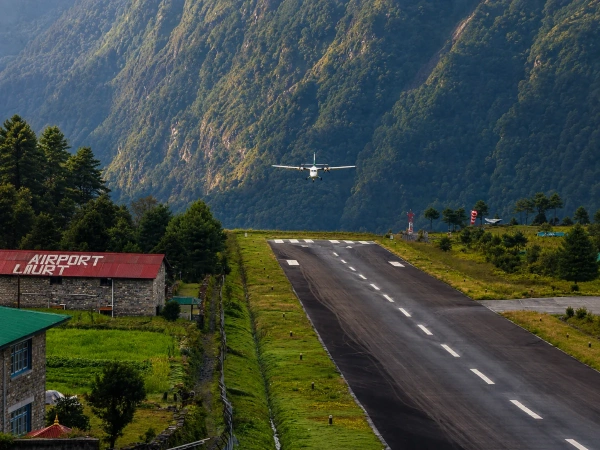
  • Lukla Airport (2,846 m).
  • Namche Bazaar (3,440 m).
  • Monasteries at Tengboche (3,867 m).
  • Sherpa Villages and Culture.
  • Mountaineering Training at Island Peak Base Camp (5,087 m).
  • High-altitude glacier and snow terrain.

Key Takeaway: Dawa Choling Gompa is the largest monastery located at Tengboche.

Short Itinerary & Altitude

Everest Base Camp Trek with Island Peak Climbing - 17 Days

Island Peak Climbing with EBC Trek – 17 Days Detailed Itinerary

Nature Lovers Treks and Tours has prepared a perfectly planned 17-day itinerary for Island Peak Climbing combined with the Everest Base Camp Trek, reaching over 6,189 m above sea level. In the first half of the journey, trekkers will reach Kala Patthar (5,545 m), and in the second half, trekkers will attempt the Island Peak summit climb.

Day 1

Arrival in Kathmandu (1,400 m)

Climbers will land at Tribhuvan International Airport, and our team will guide you to your allocated hotel room in a private vehicle. Climbers can spend time exploring Thamel, preparing their gear and equipment for the summit. No trekking activities are scheduled today, so arrange your permit, documents, backpack, gear, and equipment.

Day 2

Fly to Lukla (2,610 m) from Kathmandu/Ramechhap and trek to Phakding (2,610 m)

Direct Lukla flights from Kathmandu are crowded in spring and autumn, so climbers can board a Lukla flight from Manthali Airport in Ramechhap. The flight takes around 25 to 30 minutes depending on weather conditions. After landing at Lukla, climbers will do a short hike to Phakding the same day.

Day 3

Trek from Phakding to Namche Bazaar (3,440 m)

Climbers will cross the Dudh Kosi River on suspension bridges decorated with prayer flags. The trek from Phakding to Namche Bazaar takes 5 to 6 hours of ascent on rocky trails, crossing the highest Hillary Suspension Bridge. Climbers will cover around 10 to 11 km and spend the night in Namche Bazaar.

Day 4

Acclimatization day in Namche | Hike to Hotel Everest View (3,880m)

The first rest day of your journey, but climbers will spend this day joining a short hike to Hotel Everest View. The journey takes around 3 to 4 hours depending on your walking pace. Climbers can enjoy the bakeries, restaurants, bars, gear shops, and huge Saturday market. Climbers will descend back to Namche Bazaar to spend the night.

Day 5

Trek from Namche Bazaar to Tengboche (3, 860 m)

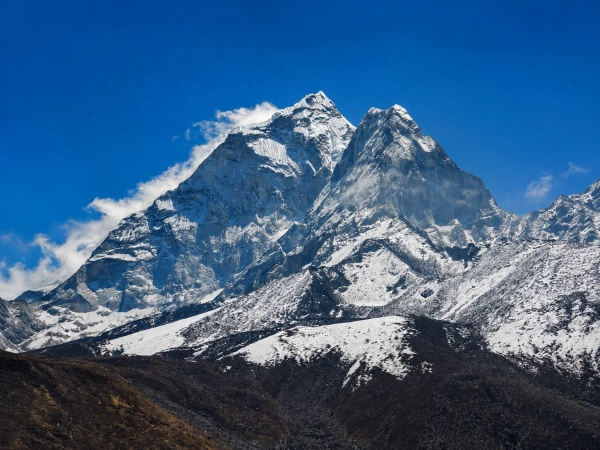
The journey continues from Namche Bazaar to Tengboche and takes around 5 to 6 hours of ascent on rocky trails of the Everest region. With good weather and clear skies during spring and autumn, climbers can enjoy breathtaking views of Mount Ama Dablam. Tengboche is also famous for Tibetan Buddhism-influenced ancient monasteries.

Day 6

Trek from Tengboche to Pheriche (4,371 m)

The trek from Tengboche to Pheriche takes 4 to 5 hours of walking on uneven Khumbu trails. The climber will cross dense forest and cover 9 to 10 km to reach Pheriche to spend the night. The Himalayan Rescue Association’s seasonal clinic in Pheriche treats the symptoms of acute mountain sickness for trekkers and climbers.

Day 7

Acclimatization day in Pheriche | Hike to Nangkartshang Peak (5,083 m)

The second rest day of the journey before the long ascent day to Everest Base Camp and Kala Patthar. Climbers will join a short preparation hike to Nangkartshang Peak, which takes around 4 to 5 hours, and descend back to Pheriche for an overnight stay. 

Day 8

Trek from Pheriche to Lobuche (4,940 m)

The shortest walking day from Pheriche to Lobuche, which takes around 4 to 5 hours, exploring the Himalayan trails of the Everest region. Climbers will only cover 7 km and spend the night in Lobuche, preparing for the most physically demanding day of the itinerary.

Day 9

Trek Lobuche to Gorak Shep (5,164 m) and Everest Base Camp (5,364 m)

The most physically demanding day of the first half of the Island Peak climbing with the EBC trek. The trek from Lobuche to Gorak Shep via Everest Base Camp takes around 8 to 9 hours of ascent and descent on rocky trails. Climbers will cover around 13 to 15 km and spend the night in Gorak Shep. 

Day 10

Morning hike to Kala Patthar (5,545 m) and trek to Dingboche (4,410 m)

Kala Patthar is the highest point of the EBC Trek, offering 360-degree mountain views under the clear skies. The trek from Gorak Shep to Kala Patthar and descent back to Dingboche takes around 6 to 7 hours. Climbers will cover 17 to 18 km and spend the night in Dingboche.

Day 11

Trek from Dingboche to Chhukung (4,730 m)

The start of the second half of the journey to conquer the Island Peak summit. The trek from Dingboche to Chhukung takes 2 to 3 hours of walking, so climbers rest after two long walking days.

Day 12

Trek from Chhukung to Island Peak Base Camp (5,087 m)

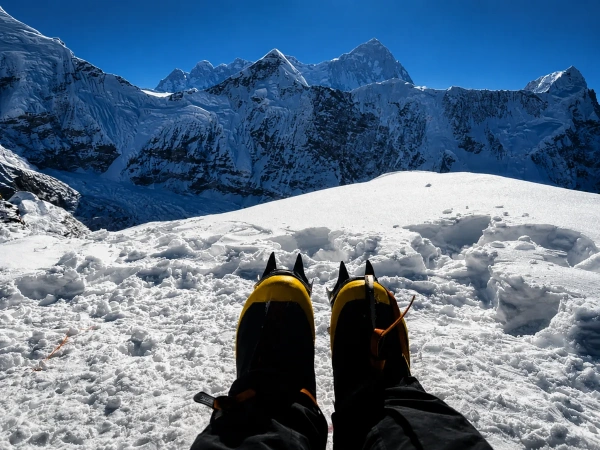
Trek across glacial moraines to reach Island Peak Base Camp, situated in the spectacular Imja Valley at over 5,000 m. Set up your high-altitude camp, complete a final equipment check for crampons, harness, ice axe, and ascender, and rest fully for summit day.

Day 13

Summit Island Peak (6,189 m) and descend back to Chhukung

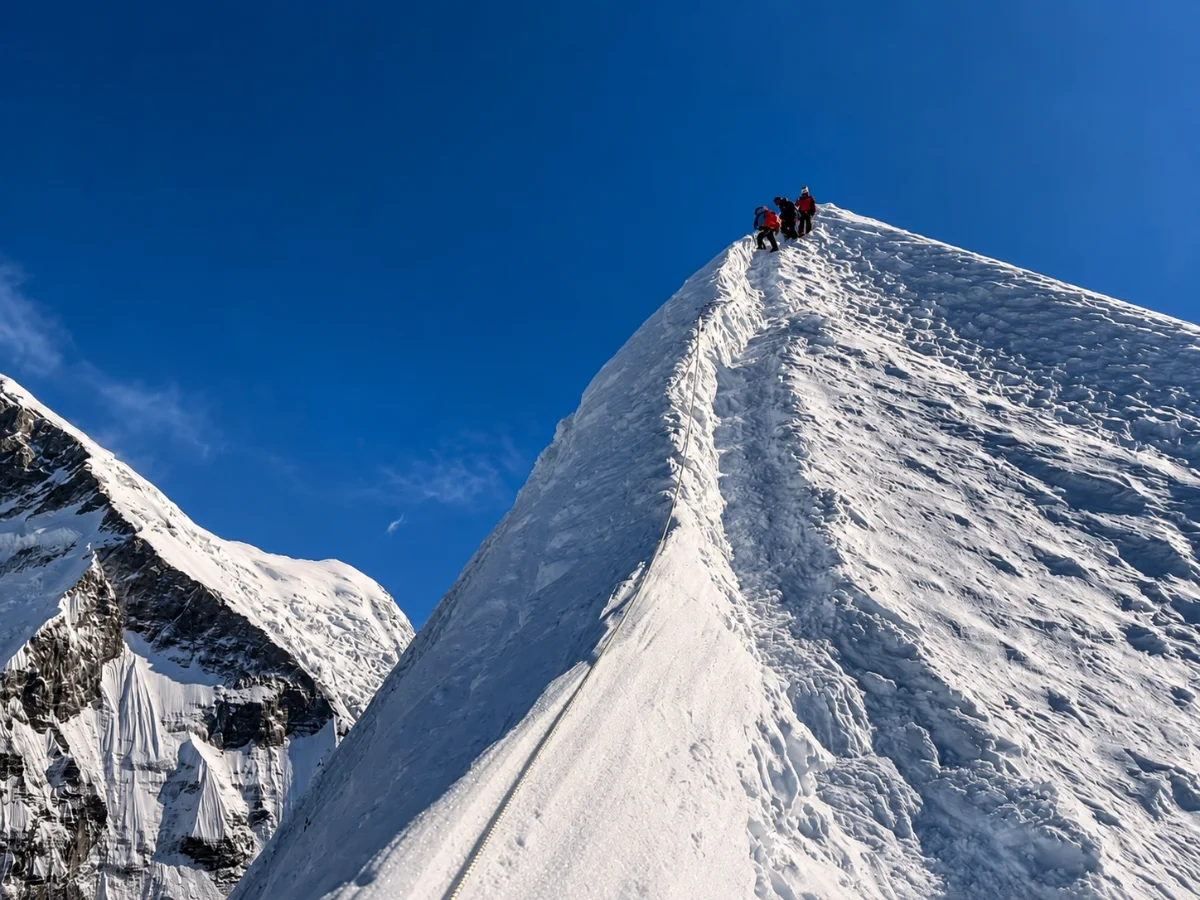
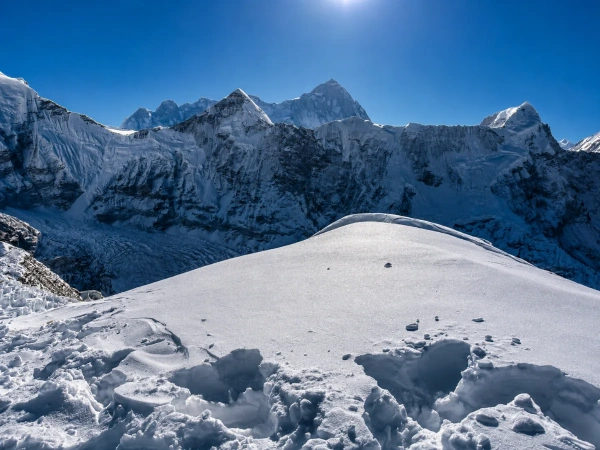
The most important and technically demanding day of the entire 17-day Island Peak Climbing with EBC Trek. Climbers will ascend the summit with the help of a rope, and the entire summit push takes around 10 to 12 hours, walking on snowy trails of the Everest region. After summiting Island Peak, climbers descend back to Chhukung to spend the night and get proper rest.

Day 14

Descend from Chhukung to Namche Bazaar (3,440 m)

The long descent from Chhukung to Namche Bazaar takes around 6 to 7 hours of downhill walking. Climbers will cover 19 to 20 km from Chhukung to Namche Bazaar and spend the night in a comfortable hotel.

Day 15

Descend from Namche Bazaar to Lukla (2,860 m)

The last day of walking on the rocky trails of the Khumbu/Everest region, exploring the Sherpa culture villages, and descending back to Lukla from Namche Bazaar. The descent takes around 6 to 7 hours, covering 9 to 10 km, and you spend the night at Lukla.

Day 16

Fly from Lukla to Kathmandu/Ramechhap (1,400 m)

Climbers will fly from Lukla to Kathmandu/Ramechhap depending on weather conditions. The flight lasts 25 to 30 minutes, and you can spend the remaining time as you wish. Depending on the weather, climbers have to land at Manthali Airport in Ramechhap and take a short drive to Kathmandu.

Day 17

Final Departure

Our team will transfer you to Tribhuvan International Airport in a private vehicle. Climbers have completed the 17-day Island Peak Climbing with EBC Trek, and now they can return to their home country, waving goodbye to the beautiful Himalayan trails of Nepal. 

Still Confused?
No worries. Our team is ready to guide you every step of the way.

Cost Details

Includes

  • Airport pick-up and drop in a private vehicle throughout the package.
  • Two nights in a premium hotel in Kathmandu on a bed and breakfast basis.
  • Domestic flights: Kathmandu or Manthali to Lukla and return, with a 10 kg plus 5 kg baggage allowance.
  • Sagarmatha (Everest) National Park entry permit.
  • Khumbu Pasang Lhamu Rural Municipality trekking permit.
  • Island Peak climbing permit issued by the Nepal Mountaineering Association.
  • TIMS (Trekkers Information Management System) card.
  • 14 nights of accommodation in the best available teahouses and lodges on a twin or double sharing basis.
  • Two nights of accommodation at Island Peak Base Camp with high-altitude tents.
  • All meals during the trek: breakfast, lunch, and dinner.
  • Daily seasonal fresh fruit.
  • Professional, government-licensed, English-speaking lead trek guide.
  • Certified Island Peak climbing guide and dedicated high-altitude climbing Sherpa.
  • Porter service, shareable between two trekkers.
  • Salary, meals, accommodation, insurance, and transport for all guide and support staff.
  • Group technical climbing equipment including fixed ropes, ice screws, snow pickets, and communal safety gear.
  • First aid medical kit with pulse oximeter, carried by the guide throughout the trek and climb.
  • Complimentary Nature Lovers Treks and Tours T-shirt, duffel bag, and route map.
  • Complimentary farewell dinner in Kathmandu.
  • Trek and summit completion certificate.
  • All applicable government taxes and service charges.

Excludes

  • International airfare and Nepal entry visa fee, payable on arrival at Kathmandu airport.
  • Meals and sightseeing costs during your time in Kathmandu.
  • Comprehensive travel insurance covering emergency helicopter evacuation, medical expenses, and mountaineering activities above 6,000 m. This is mandatory.
  • Personal trekking and climbing gear including crampons, harness, and ice axe.
  • Personal expenses on the trail such as laundry, phone calls, battery charging, Wi-Fi, hot showers, hot or cold beverages, snacks, and souvenirs.
  • Tips for guides, Sherpas, and support staff, which are highly recommended by the Nepali trekking industry.
  • Any extra nights or accommodation not specified in the itinerary.
  • Helicopter evacuation or rescue costs, which should be covered by your travel insurance.

Essential Information

How Difficult Is Island Peak Climbing with EBC Trek?

The 17-day Island Peak Climbing with EBC Trek is strenuous because the trails demand long walking days and climbing skills.

Overall Island Peak Climbing With EBC Trek Difficulty Level

Trekkers require 6 to 7 hours of daily walking and mountaineering skills on uneven trails of the Khumbu region, so Island Peak climbing difficulty is graded as strenuous. Trekkers should have good fitness, and acclimatization can easily complete the first half of the adventure. The second half, starting from Chhukung and going to the Island Peak summit, requires climbing skills, proper gear, equipment, and movement skills.

Trekking Difficulty vs Climbing Difficulty

The 17-day Island Peak Climbing with EBC Trek is divided into two sections. In the first part, trekkers will reach Kala Patthar (5,545 m), the highest point of the Everest Base Camp trek. The journey includes two acclimatization days at Namche and Pheriche before ascending to Everest Base Camp and Kala Patthar.

The second part starts from Chhukung to Island Peak Summit, 6,189 m above sea level. Climbers must follow their guide's instructions and need an ice climbing experience certificate for this journey. Climbers will cross 5,500 m, increasing the risk of suffering from acute mountain sickness, and the trail is technically demanding.

High-Altitude Challenges

The human body needs a proper supply of oxygen to function properly, and on this 17-day journey, trekkers will reach Island Peak summit at 6,189 m above sea level. After crossing 3,000 m, you will notice symptoms of altitude sickness, such as breathing difficulty, fatigue, cold, and headache. So at high-altitude trekking destinations, proper acclimatization days and slow ascent are important for safety and comfort.

Long Trekking Days

Normally, trekkers will walk around 6 to 7 hours daily for the entire journey. But on day 9, the trek from Lobuche to Gorak Shep through Everest Base Camp is the most physically demanding day of the first half of the itinerary. Trekkers will walk around 7 to 8 hours to reach Gorak Shep. Then, the summit attempt takes around 10 to 12 hours of technical climbing.

Is Island Peak Suitable for First-Time Climbers?

Yes, with the proper travel guide, itinerary, preparation, and acclimatization, Island Peak is suitable for first-time climbers. Every year, hundreds of trekkers attempt the Island Peak summit during spring and autumn with proper guiding, equipment, and gear. Many trekkers also believe that the Island Peak summit is the starting point of a Himalayan mountaineering journey.

Key Takeaway: Spring (March-May) and autumn (September-November) are the two best seasons for Island Peak climbing with EBC Trek.

Permits Required for Island Peak Climbing with EBC Trek

Trekkers need the Island Peak Climbing Permit, the Sagarmatha National Park Entry Permit, and the Khumbu Local Permit to complete the Island Peak summit.

Island Peak Climbing Permit

The Island Peak Climbing Permit is issued by the Nepal Mountaineering Association (NMA), located in Kathmandu. The NMA manages more than 20 to 30 high-altitude trekking peaks located in Nepal. Climbers must apply for the permit through a government-registered agency and cannot obtain it independently or at different checkpoints. 

Island Peak Climbing Permit Cost

The Nepal Mountaineering Association (NMA) changed the fee structure for Island Peak Climbing permits depending on the season.

  • Spring (March-May): USD 250-350 per person.
  • Autumn (September-November): USD 175-200 per person.
  • Winter (December-February): USD 175-200 per person.
  • Summer/Monsoon (June-August): USD 175-200 per person.

Key Takeaway: Some websites still show the older fee structure for Island Peak Climbing, so ask your trekking agency team for the current permit cost.

Sagarmatha National Park Entry Permit

Island Peak is located inside the Sagarmatha National Park, so climbers must have a national park entry permit to start their climbing adventure. Climbers can apply for this permit from the Nepal Tourism Board office located in Kathmandu or at the Monjo checkpoint. The money collected from permits helps in development projects in the Everest region and trail maintenance.

Sagarmatha National Park Entry Permit Cost

The cost for the Sagarmatha National Park entry permit is

  • Foreign citizens: NPR 3,000 per person.
  • SAARC nations: NPR 1,500 per person.
  • Nepali citizens: NPR 100 per person.

Khumbu Local Permit

Climbers can obtain the Khumbu Local Permit, also known as the Khumbu Pasang Lhamu Rural Municipality Permit, directly at Lukla or Monjo before the Sagarmatha National Park entry gate. The funds are later used for infrastructure development, trails, and bridge maintenance in Khumbu villages.

Khumbu Local Permit Cost

  • Foreign citizens: NPR 2,000 per person.
  • SAARC nations: NPR 2,000 per person.
  • Nepali citizens: NPR 2,000 per person.

Key Takeaway: Trekkers must have a valid Nepal visa and passport to apply for the Island Peak Climbing with EBC Trek permits.

Who Arranges the Permits?

All the permits for Island Peak Climbing with EBC Trek are managed by your trekking agency and your travel guide. Climbers cannot apply for the permit independently from the Nepal Mountaineering Association. From 2023, climbers and trekkers must travel with a licensed guide for their safety and comfort.

Best Time for Island Peak Climbing with EBC Trek

Spring (March-May) and Autumn (September-November) are the best times for starting your Island Peak Climbing with EBC Trek. Trekkers can enjoy the warm temperatures, comfortable weather, and blooming forests, perfect for long walking days.

Island Peak Climbing in Spring (March-May)

Spring (March-May) is the best season for Island Peak climbing combined with the Everest Base Camp trek. The season brings warm temperatures, stable weather, clear skies, and rhododendron forests, perfect for high-altitude trekking. The trail conditions are good, and stable weather makes navigation easier.

Island Peak Climbing in Autumn (September-November)

Autumn (September-November) is the most crowded season for Khumbu/Everest region trekking in Nepal. After the heavy monsoon rainfall, it brings the clearest skies, best for mountain photography. Autumn brings comfortable weather and warm temperatures, and many famous festivals in Nepal are celebrated in this season, perfect for the Island Peak summit push.

Island Peak Climbing in Winter (December-February)

A winter (December-February) summit push is possible but risky for both beginners and professional climbers. In winter, temperatures drop below -20°C, and unstable weather makes navigation difficult for the summit push. Climbers can expect unannounced avalanches and snowy trails, which are extremely dangerous in high-altitude climbing.

Island Peak Climbing in Monsoon (June-August)

Monsoon (June-August) is the worst season for Island Peak climbing with the EBC Trek. The heavy rainfall at lower altitudes, snowy trails, unpredictable weather, and poor visibility make the entire summit push impossible. The Lukla flights are delayed for days, weeks, and even months because of unstable weather and heavy rainfall.

What are the best months for the Island Peak Summit Push?

Late April to mid-May and October to early November are the best months for the Island Peak summit push combined with the Everest Base Camp Trek. The stable weather, dry trails, clear skies, and warm temperatures are perfect for high-altitude trekking and summit climbing.

Key Takeaway: June to August are the worst months for the Island Peak Summit Push with the EBC Trek.

Final thoughts on 17 Days Island Peak Climbing with EBC Trek

The 17-day Island PeakClimbing with EBC Trek is strenuous because the itinerary combines the summit push with the Everest Base Camp trek. The trails are physically and technically demanding, with long walking days on rocky trails of the Everest region. But Island Peak Climbing is the perfect journey for beginner climbers searching for a high-altitude adventure. The trails reward climbers with mesmerizing mountain views of the entire Khumbu/Everest region. Nature Lovers Treks and Tours offers the best budget-friendly package for Island Peak Climbing with EBC Trek, providing a comfortable journey without compromising comfort throughout the trek. What are you waiting for? Contact our Nature Lovers Treks and Tours team, and let us handle all the logistics so you can focus on making unforgettable memories with your friends and family.


Island Peak Climbing with EBC Trek – 17 Days FAQs

Spring (March-May) and autumn (September-November) are the two best seasons for Island Peak climbing. 

Key Takeaway: Many famous festivals in Nepal, such as Dashain and Tihar, are celebrated in mid-autumn. 
 

The Island Peak Climbing with EBC Trek is a 17-day combined journey exploring Everest Base Camp with a technical climb of Island Peak (6,189 m).

Key Takeaway: Imja Tse is the official name of Island Peak, assigned by the government of Nepal in 1983.
 

The Island Peak Climbing difficulty, combined with the EBC trek, is strenuous because the trail demands technical mountaineering skills to reach the summit at 6,183 m above sea level.

Key Takeaway: The summit climb involves crampons, an ice axe, a harness, an ascender, fixed ropes, glacier travel, and a steep snow/ice headwall.
 

Yes, beginners with proper preparation and hiking experience can climb Island Peak and do the Everest Base Camp trek. Climbing Island Peak (6,189 m) is also known as the first step to learning mountaineering skills.

Key Takeaway: Beginner climbers need to complete a multi-day, moderate hike, including Everest Base Camp, before starting Island Peak Climbing.
 

No, you don’t require any prior climbing experience because your guide will teach you basic climbing skills, crampon use, jumar ascent, and rope safety before the summit attempt.

Key Takeaway: Climbers must be physically prepared and take all training sessions seriously for a high success rate of reaching the Island Peak summit.
 

Island Peak is located in the Khumbu region near Chhukung and is also known as Imja Tse (6,189 m above sea level).

Key Takeaway: After crossing 3,000 m above sea level, there is a high chance of suffering from acute mountain sickness.
 

Everest Base Camp is 5,364 m above sea level, and the trail doesn’t demand any technical mountaineering skills, but trekkers need to be prepared for long walking days on rocky trails in the Everest region.

Key Takeaway: Kala Patthar (5,545 m) is the highest point of the Everest Base Camp trek.    
 

Yes, Climbing Island Peak is harder than the Everest Base Camp trek because the summit trail demands technical mountaineering skills.

Key Takeaway: The summit is located 6,189 m above sea level. 
 

The steep upper headwall ascent using fixed ropes and crampons on snow trails is the hardest part of Island Peak climbing.

Key Takeaway: During the summit push, altitude sickness is common because of high altitude, cold, continuous ascent, fatigue, harsh weather, and low oxygen levels.
 

Climbers reach the summit at 6,189 m above sea level, which takes around 10 to 12 hours to cross the steep upper headwall covered in snow.

Key Takeaway: Climbers need strong physical fitness, rope climbing, and other mountaineering skills for the summit push. 
 

The important equipment required for Island Peak climbing is

  • Crampons
  • Ice axe
  • Climbing harness
  • Helmet
  • Jumar
  • Fixed ropes
  • Warm layering system
     

Yes, climbing the steep upper headwall of Island Peak is more technically demanding than the straight, snowy road to Mera Peak.

Key Takeaway: Mera Peak (6,476 m) is higher than Island Peak (6,189 m) and is physically demanding to reach because of its remoteness. 
 

The Island Peak summit, combined with the EBC trek, takes around 17 to 20 days, depending on your acclimatization days.

Key Takeaway: A 17-day itinerary includes two acclimatization days (Namche and Pheriche) and one summit training day at Island Peak Base Camp. 
 

Climbers require three important permits for Island Peak climbing:

  • Sagarmatha National Park Entry Permit
  • Khumbu Pasang Lhamu Rural Municipality Permit
  • Island Peak Climbing Permit

Key Takeaway: The Island Peak Climbing Permit is issued by the Nepal Mountaineering Association, also known as NMA. 
 

Yes, you can rent important climbing gear such as crampons, ice axes, harnesses, and helmets in Kathmandu.

Key Takeaway: Most of the best-quality gear and equipment is rented in Kathmandu's Thamel district. 
 

You May Also Like

Most popular trekking destination in Nepal
Everest Base Camp Trek
5.0(4 Reviews)

Everest Base Camp Trek - 14 Days

From
US$1299
US$1450
EBC trek with Heli return from Gorak Shep
Everest-Base-Camp-trail
Luxury EBC Trek
Everest Base Camp Luxury Trek - 11 Days
Need Help? Call Us+977 9851254172