Everest Base Camp Trek with Helicopter Return - 12 Days

171 Reviews in TripAdvisor
57 Reviews in Google

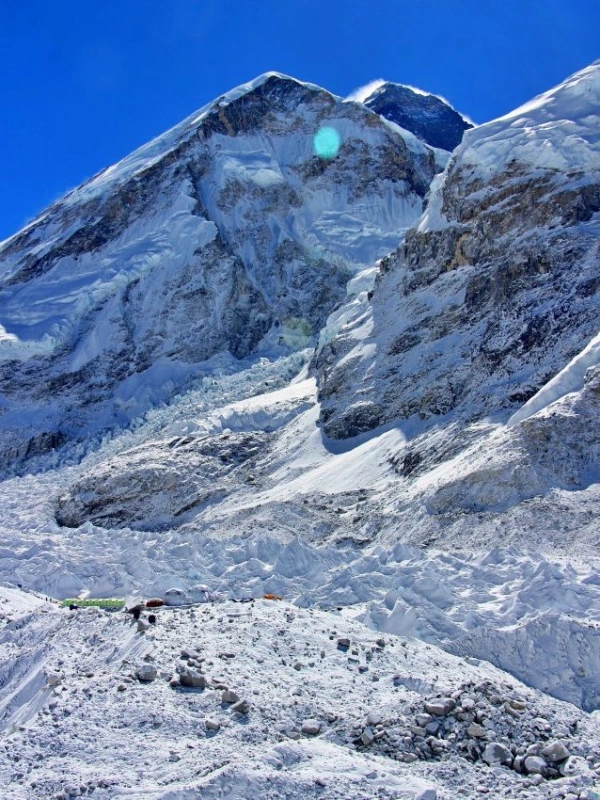
The Everest Base Camp Trek with Helicopter Return is one of Nepal's most popular high-altitude adventures. Travelers will explore the trails of the world's highest mountain. The twelve-day journey rewards trekkers with the opportunity to explore the legendary trails of the Khumbu region. The helicopter return itinerary makes the descent easier, saving extra days compared to theclassic EBC trek.

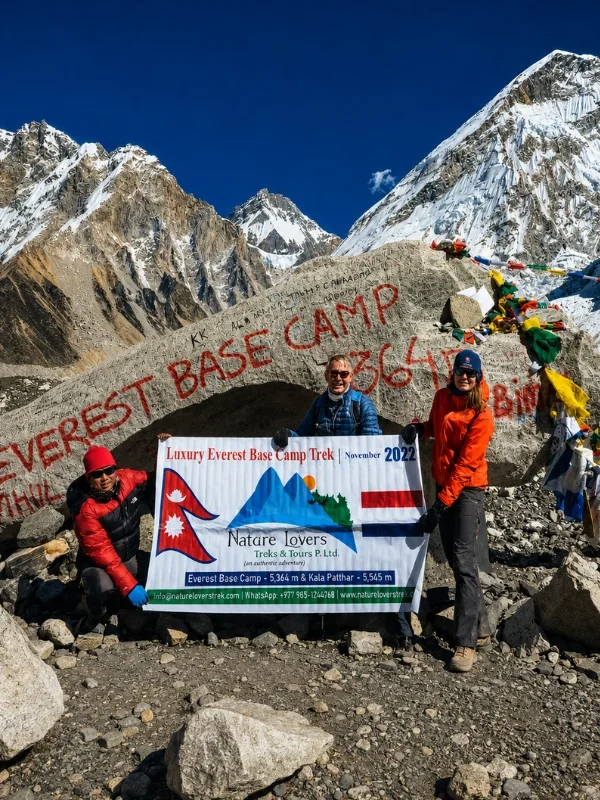
Trekkers will cross many suspension bridges, Sherpa villages, and monasteries to reach Everest Base Camp (5,364 m) and Kala Patthar (5,545 m). Trekkers will spend 3 days less, making their descent easier with a helicopter. The Everest Base Camp Trek with Helicopter Return is the perfect choice for adventureseekers with limited time who wish to reduce physical strain on the descent. 

The Everest Base Camp Trek with Helicopter Return follows the simple 12-day itinerary. Trekkers will fly into Lukla, then trek to Namche Bazaar, Tengboche, Dingboche, and the final push from Gorak Shep to Everest Base Camp and Kala Patthar. Trekkers will descend by helicopterfrom Gorak Shep for a flight out to Kathmandu. Nature Lovers Treks and Tours has brought you a properly planned 12-day itinerary that covers all costs, permits, transportation, accommodation, a licensed guide, and other logistics.
 

Duration
12 Days
Trip Grade
Strenuous
Country
Nepal
Max Altitude
5,555 meters
Starts
Flight from Kathmandu to Lukla
Ends
Shared helicopter flight from Gorak Shep to Kathmandu
Group Size
Flexible
Activities
Trekking and Hiking
Best Time
Spring (March - May) | Autumn (September - November)

What is the Everest Base Camp Trek with Helicopter Return?

Overview of the Trek

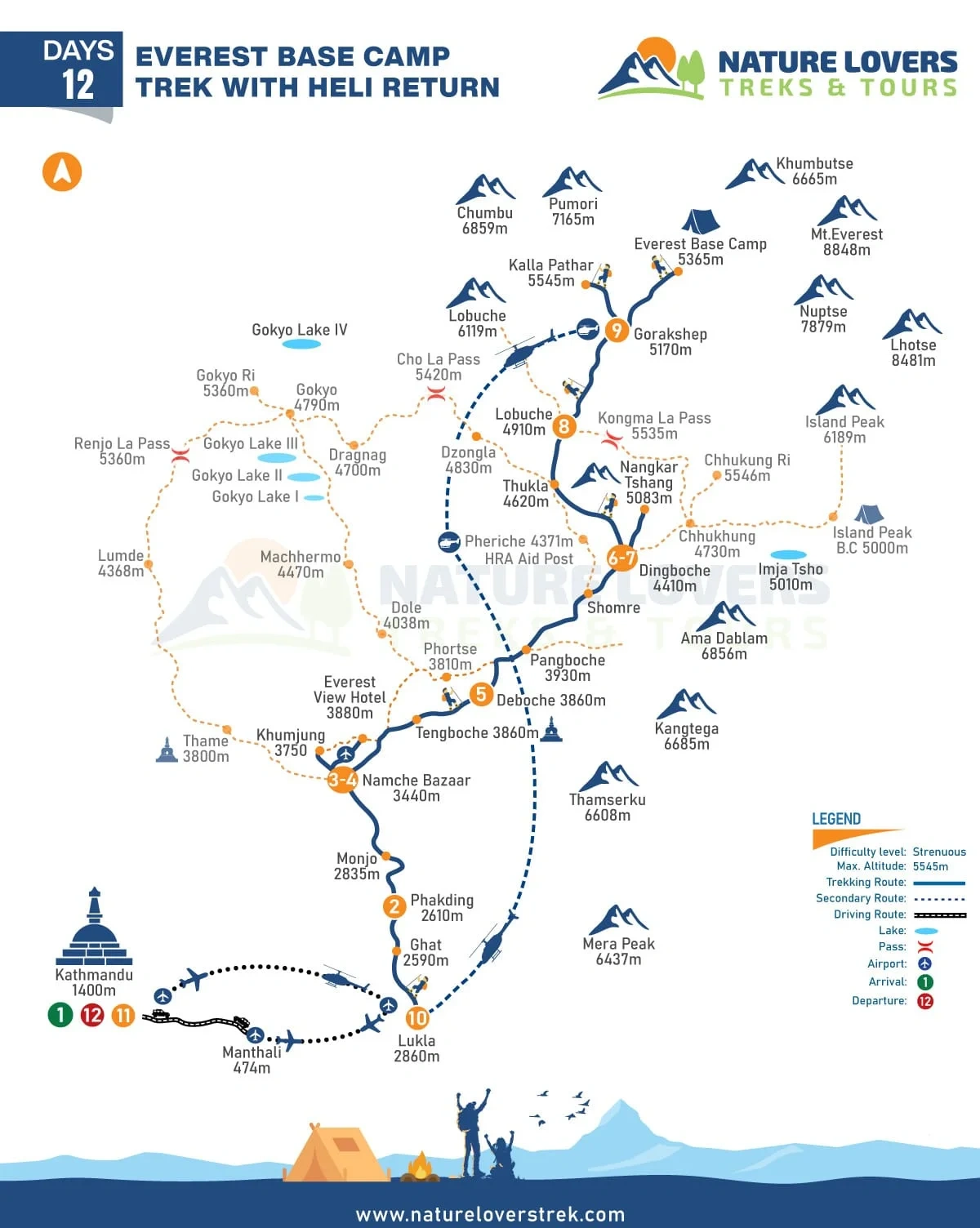
The Everest Base Camp Trek with Helicopter Return follows the same classic EBC trek route for the first ten days. Kathmandu to Lukla, trek to Phakding, Namche Bazaar, Tengboche, and Dingboche to Lobuche, and the final push for EBC and Kala Patthar from Gorak Shep. On the tenth day, instead of descending back through the same village, trekkers board a helicopter at Gorak Shep to reach Lukla.

How does the helicopter return work?

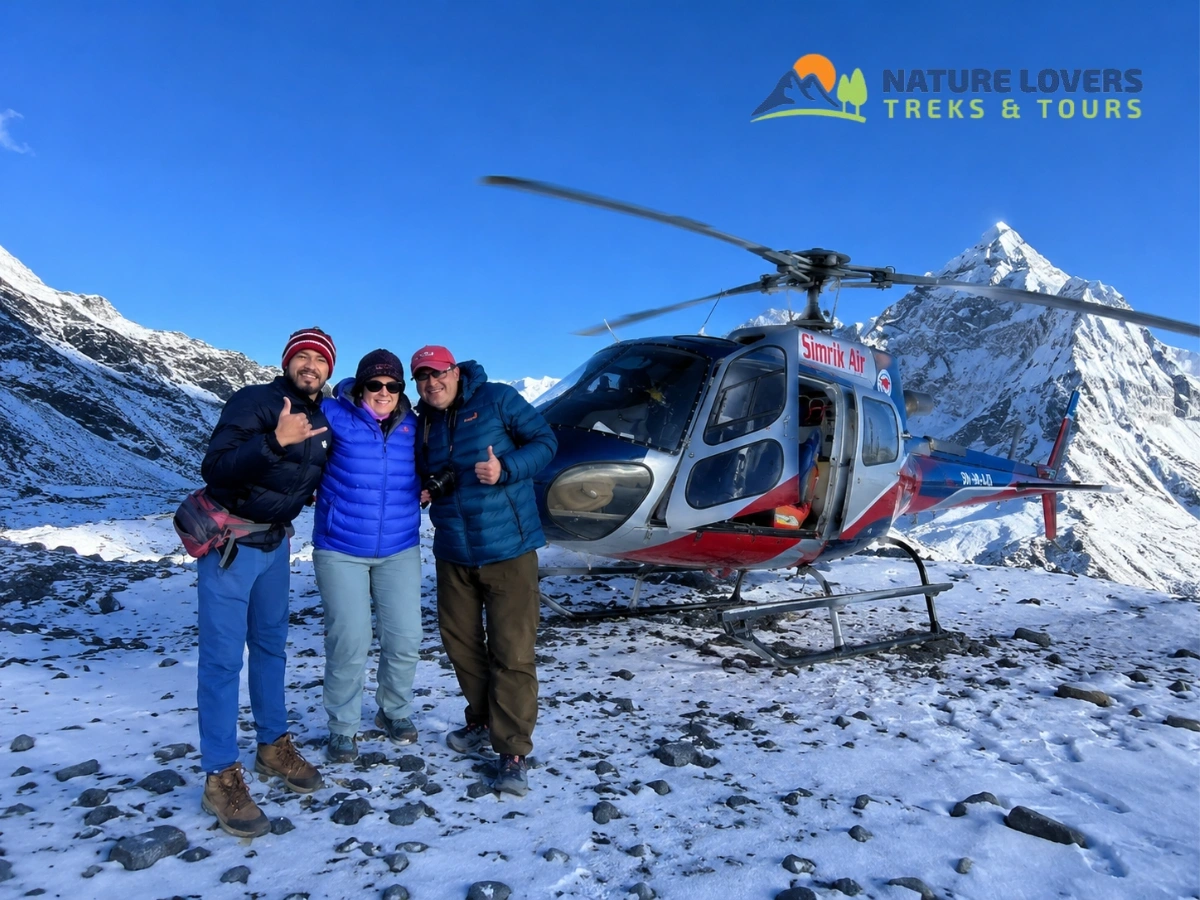
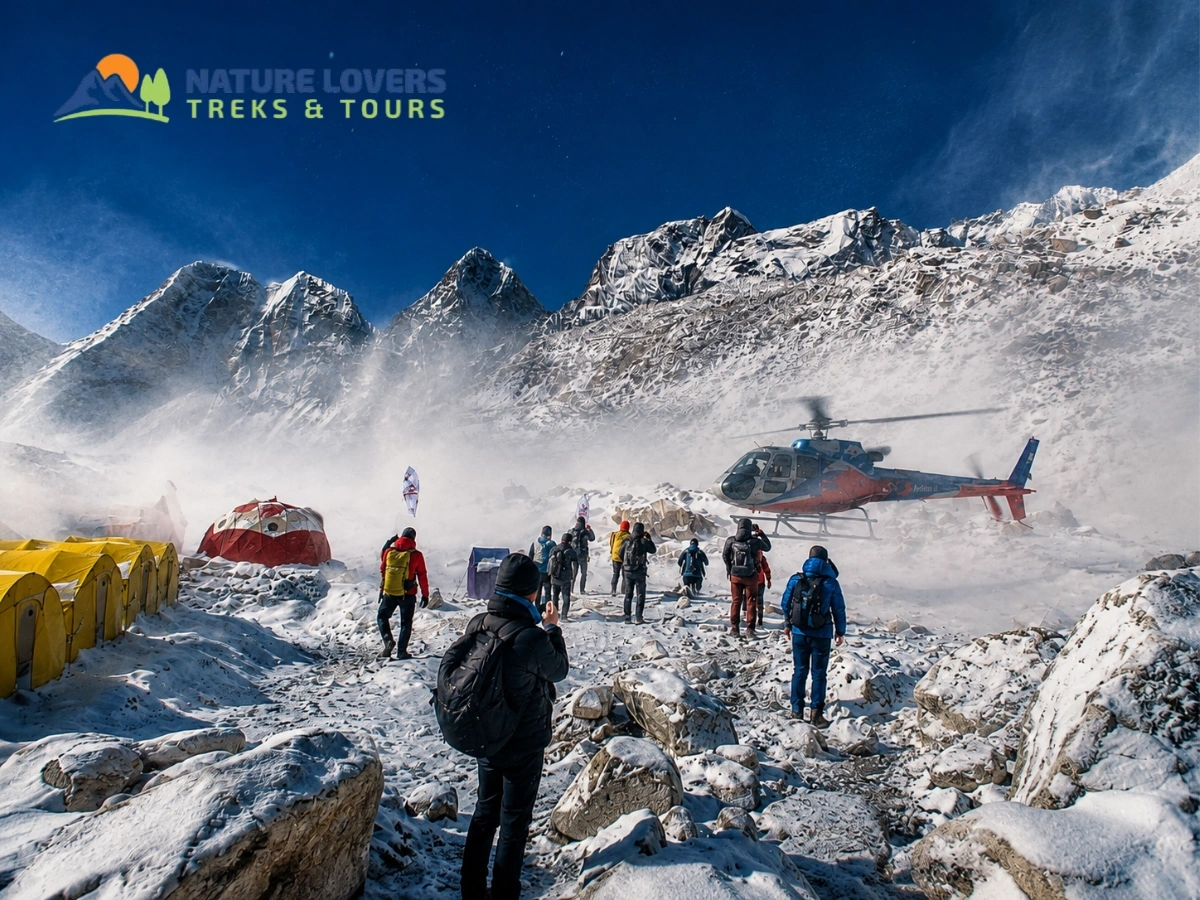
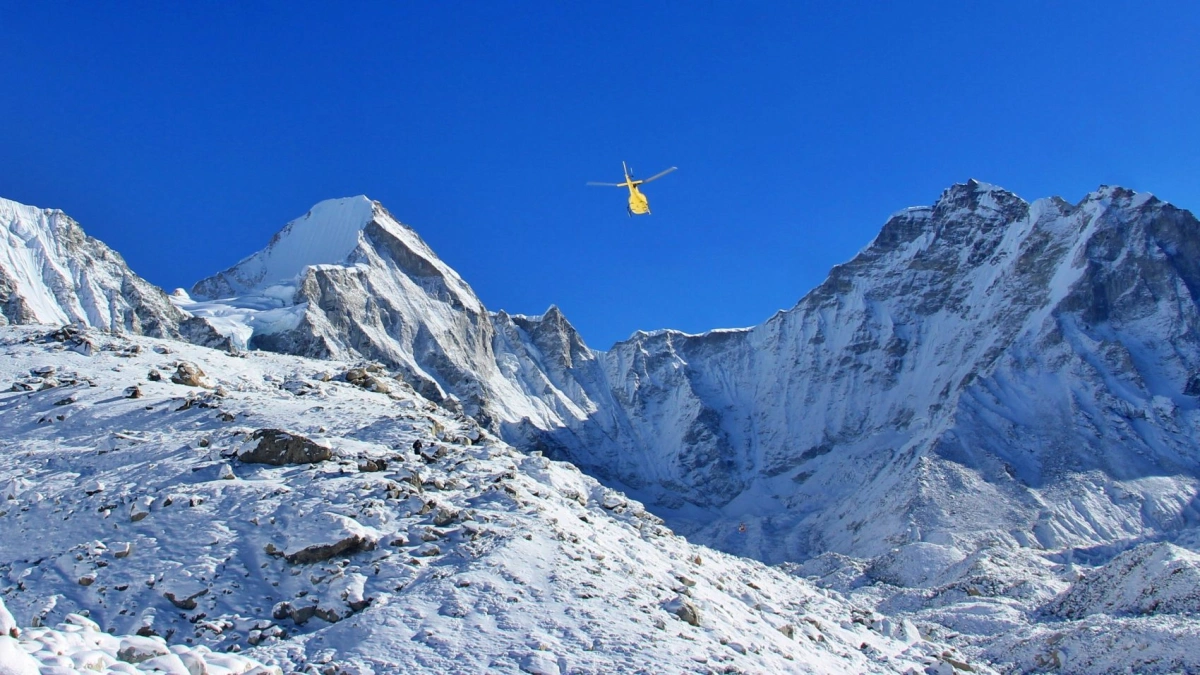
Trekkers will follow the classic EBC trek itinerary and ascend to Kala Patthar. After the ascent, trekkers descend to Gorak Shep and board a shared or private helicopter to reach Lukla. For trekkers' safety, at altitudes above 5,000 meters, only 2 people are allowed to board a helicopter. The helicopter will make multiple rotation trips from Gorak Shep to Pheriche (4,371 m), and from Pheriche, a maximum of 5 people can share a single helicopter to reach Lukla.

The helicopter flight lasts around 20 to 35 minutes, offering majestic views of the entireEverest region from a different angle. Trekkers can enjoy snow-capped mountains such as Pumori, Nuptse, Ama Dablam, Makalu, Khumbu Glacier, and many other tall peaks. It also reduces the physical strain of 10 days of continuous climbing and descending on rocky trails, making it easier for trekkers.

Why Choose a Helicopter Return Instead of Trekking Back?

Trekkers have to descend back to Lukla from Gorak Shep, which takes around 3 to 4 days walking the same difficult rocky route. Boarding the helicopter from Gorak Shep to reach Lukla saves multiple days of descent through difficult trails. Travelers can spend the remaining time exploring different popular places in Nepal, such as Chitwan and Pokhara. Travelers can also rest in Kathmandu and explore the UNESCO World Heritage sites with cultural and historical importance.

Highlights of the Everest Base Camp Trek with Helicopter Return

The entire journey offers authentic Everest region Sherpa culture combined with high-altitude Himalayan adventure. A few highlighted parts of your Everest Base Camp trek with helicopter return are given below:

  • Trek to Everest Base Camp (5,364 m).
  • Sunrise from Kala Patthar (5,545 m), the highest point of the entire trek.
  • Mesmerizing view of mountains such as Pumori, Nuptse, Ama Dablam, Makalu, and Khumbu Glacier.
  • Scenic helicopter flight over the Himalayas.
  • Sherpa Culture and Traditional Villages.
  • Sagarmatha National Park Wildlife.


Short Itinerary & Altitude

EBC-Trek-with-Helicopter-Return-Route-Map

Everest Base Camp Trek with Helicopter Return - 12 Days Detailed Itinerary

Nature Lovers Treks and Tours has made a perfectly planned 12-day itinerary for Everest Base Camp with helicopter return. Remember, due to uncertain weather conditions, there is a high chance of being delayed by 1 or 2 days, and the Gorak Shep helicopter pickup might be delayed by 1 to 2 hours.

Day 1

Arrival in Kathmandu and transfer to Hotel (1,400 m)

Travelers will land at Tribhuvan International Airport on their first day. Our team will pick you up from the airport and transfer you to the nearest hotel in Thamel. You can drop your luggage and spend the remaining time preparing your trekking gear and equipment in Thamel.

Day 2

Drive from Kathmandu to Ramechhap and Flight to Lukla (2,860m) and Trek to Phakding (2,610m)

Normally, a drive from Kathmandu to Ramechhap takes around 3 to 4 hours. Trekkers will board the Lukla flight from Ramechhap’s Manthali Airport in peak season rather than a direct flight from Kathmandu. The flight takes around 25 to 30 minutes to reach Lukla and a 3- to 4-hour walk to reach Phakding.

Day 3

Trek from Phakding to Namche Bazaar (3,440 m)

Now trekkers will cross the popular Dudh Koshi River on high suspension bridges, also known as Hillary Bridges. The permits are checked at the Sagarmatha National Park entry point located near Monjo Jorsalle before entering Namche Bazaar.

Day 4

Acclimatization Hike from Namche to Everest View Hotel (3,880 m

Namche is located at 3,440 m above sea level, the most popular Sherpa-influenced market in the Everest region. Trekkers will spend a day joining a short hike to the Everest View Hotel that offers a majestic view of Everest’s summit alongside Ama Dablam. Then you can spend the remaining time exploring bakeries, gear shops, and the Sherpa Culture Museum.

Day 5

Trek from Namche Bazaar to Tengboche (3,860 m)

Trekkers will start their journey from Namche Bazaar, walking along Dudh Koshi Valley, offering steady views of Ama Dablam before a long descent to Phunki Tenga. Then trekkers will continue the long climb back up and reach Tengboche. Trekkers can spend the remaining time exploring Tengboche Monastery, the largest religious site in the Khumbu.

Day 6

Trek from Tengboche to Dingboche (4,410 m)

Now the trail connects the forest filled with different shades of rhododendron in Deboche after crossing Tengboche. Trekkers will enjoy the colorful trail and spend their night at Dingboche. The valley is popular for potato fields and other vegetation.

Day 7

Acclimatization Hike to Nangkartshang Peak from Dingboche (5,083 m)

The short hike to Nangkartshang Peak from Dingboche crosses 5,000 m altitude. Many trekkers skip this hike, mistaking it for a rest day. But it is the perfect short-distance trek to prepare the body for the Lobuche and Gorak Shep climb day.

Day 8

Trek from Dingboche to Lobuche via Thukla Pass (4,910 m)

Thukla Pass is a memorial site that holds the spirits of climbers and Sherpas who died on the Everest journey. Most trekking groups stop here to offer respect to fellow trekkers for their bravery. Then trekkers will walk the trails along the Khumbu Glacier and reach Lobuche

Day 9

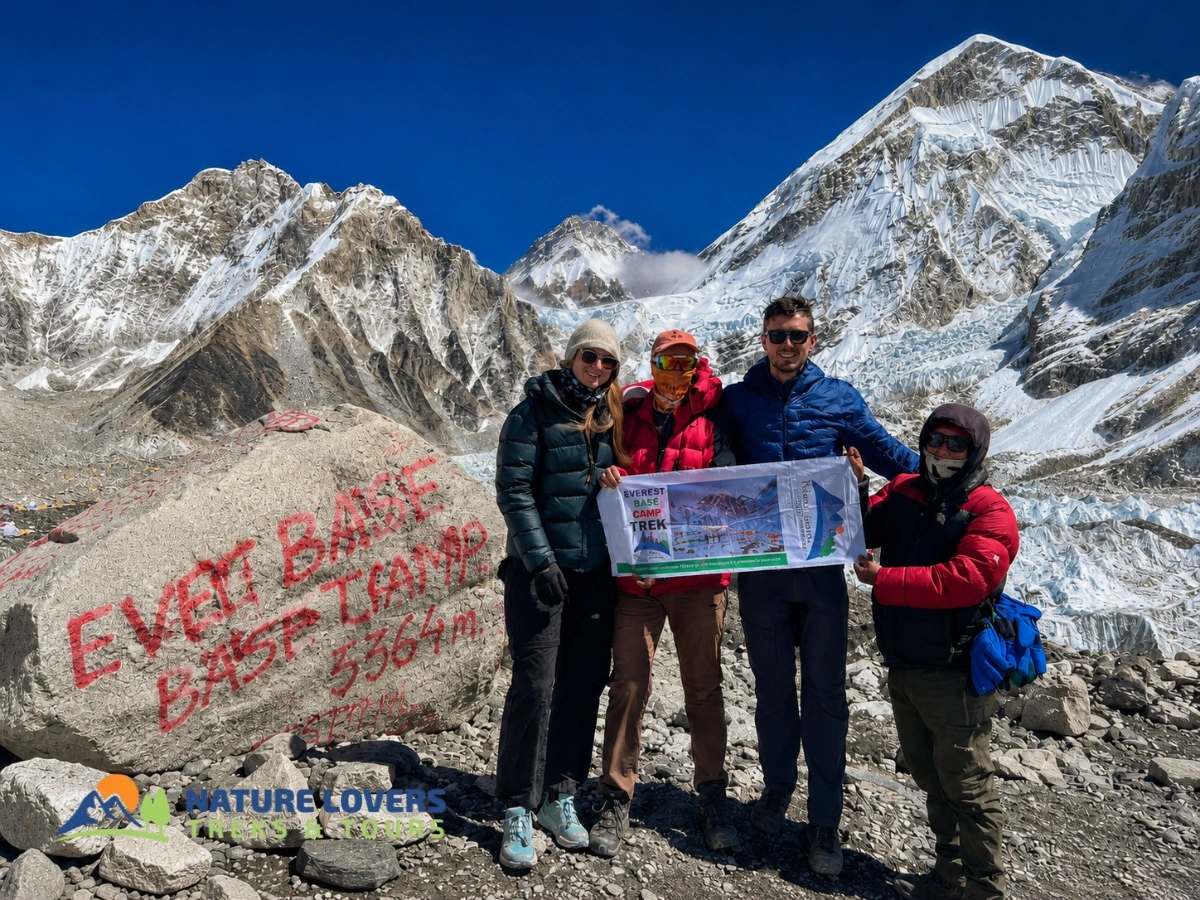
Trek from Lobuche to Gorak Shep and hike to Everest Base Camp (5,364 m)

The longest day of the entire Everest Base Camp Trek with a helicopter return journey. The climb starts in the morning to Gorak Shep, offering a constant view of mesmerizing snow-capped mountains throughout the journey. Then, after dropping bags at Gorak Shep Lodge, trekkers continue their climb to Everest Base Camp and turn back to Gorak Shep for the night.

Day 10

Hike to Kala Patthar and Helicopter flight to Lukla (5,545 m)

The trekkers will start an early morning climb from Gorak Shep to Kala Patthar before sunrise, the highest point of the Everest Base Camp Trek. Trekkers can enjoy the majestic view of Everest, Nuptse, and Pumori on a clear day. Then you will descend back to Gorak Shep andboard the short helicopter rideto Lukla.

Day 11

Fly from Lukla to Ramechhap and Drive back to Kathmandu

A short 25-minute flight from Lukla to Ramechhap’s Manthalu Airport and a 4-hour ride back to Kathmandu end your Everest Base Camp Trek with a high-altitude helicopter return adventure.

Day 12

Final Departure from Nepal

Trekkers are now free to explore different places in Nepal, such as Kathmandu Valley, Pokhara, and Chitwan, if they have a few more days to spend in Nepal. Many trekkers get proper rest, and most trekkers return to their own home country

Still Confused?
No worries. Our team is ready to guide you every step of the way.

Cost Details

Includes

  • Airport pick-up and drop-off from a private vehicle
  • 3-star hotel in Kathmandu for accommodation
  • Domestic flights: Kathmandu – Lukla – Kathmandu including airport transfers
  • Shared Helicopter flight from Gorakshep to Lukla (charter a helicopter privately for an additional fee)
  • Sagarmatha  National Park Entry Permit
  • Khumbu Pasang Lhamu Rural Municipality permit 
  • TIMS (Trekkers’ Information Management System) card 
  • Accommodation during the trek at the best available tea houses/lodges (twin sharing/couple basis)
  • All meals during the trek (breakfast, lunch, and dinner)
  • Daily seasonal fresh fruits
  • Professional, government-licensed English-speaking trek guide
  • Salary, meals, accommodation, insurance, and transportation for the guide
  • Porter service (shareable between two trekkers)
  • First aid medical kit carried by the guide
  • Complementary company t-shirt, company duffel bag & a route map
  • Complementary farewell dinner
  • Trek completion certificate
  • All government taxes and service charges

Excludes

  • International airfare and Nepal entry visa fee (payable on arrival at Kathmandu airport)
  • Meals and sightseeing in Kathmandu
  • Travel insurance (must cover emergency evacuation above 5,000 m and medical expenses)
  • Personal trekking gear and equipment
  • Personal expenses during the trek such as laundry, phone calls, battery charging, Wi-Fi, hot showers, hot/cold beverages, snacks, or souvenirs
  • Tips for the field staff (highly recommended)
  • Any extra nights and accommodation not included in the itinerary

Dates & Availability

Select Departure Dates
Sep 2026
Oct 2026
Nov 2026
Dec 2026
07 Sep, 2026
Starts on Monday
18 Sep, 2026
Ends on Friday
Guaranteed
US$2698
14 Sep, 2026
Starts on Monday
25 Sep, 2026
Ends on Friday
Guaranteed
US$2698
21 Sep, 2026
Starts on Monday
02 Oct, 2026
Ends on Friday
Guaranteed
US$2690
28 Sep, 2026
Starts on Monday
09 Oct, 2026
Ends on Friday
Guaranteed
US$2696

Add-Ons & Options

Finished your trek? Fly straight back to Kathmandu on a luxury helicopter—enjoy stunning aerial views while avoiding trekking crowds and the Lukla flight.

The most important gear for the EBC trek includes a warm down jacket, a sleeping bag rated to –20°C to –30°C, trekking poles, and micro spikes for snowy trails. These essentials can be cost expensive and inconvenient to bring from home—but no worries. You can easily rent all of them from us and return them after the trek.

Have you heard of Mountain Lodges of Nepal—the luxury hotel group operating premium lodges in the Everest region? Stay in the most comfortable lodges available and enjoy gourmet cuisine prepared by skilled chefs. This is your ticket to a truly refined Himalayan experience.

Traveling in a group of 3–5? Upgrade to a private helicopter return from Gorakshep to Lukla for better value and total privacy.

A premium Himalayan journey featuring superior lodges, expert guides, and personalized service throughout. From the moment you land in Kathmandu until your departure, every detail—and all associated costs—is fully covered. Relax and focus entirely on the experience while traveling with complete ease and confidence on this fully supported deluxe trek.

Still Confused? Consult an Expert

Equipment Lists

Nepal Everest Base Camp Trek with Helicopter Return: Necessary Gear and Equipment Checklist

Head
+
  • Trekking Hat/Cap
  • Headlamp/Flashlight (with extra batteries), good quality
  • Sunglasses (UV protection)
  • Woolen hat /Beanie (for cold weather)
  • Bandana/Buff (for dust and sun protection)
  • Sunblock (Sunscreen) (SPF 40 or higher)
  • Insect Repellent (for lower trekking areas)
Upper Body
+
  • Base Layer Shirt: Two (moisture-wicking, breathable fabric)
  • Trekking Jacket: A pair of lightweight (water-resistant/windproof)
  • Insulating Layer: A pair (fleece, down jacket, or sweater for warmth)
  • Rain Jacket/poncho (lightweight, waterproof)
  • Trekking Trousers/Pants: Two pairs (comfortable and durable)
  • Long-sleeve shirt: 1 pair (for sun or insect protection)
  • Underwear: Two pairs (moisture-wicking, quick-dry fabric)
  • Compression Garments (for reducing muscle fatigue, optional)
  • Gore-Tex or a similar waterproof jacket
Lower Body
+
  • Trekking Pants: Two pairs (convertible into shorts if needed)
  • Thermal Leggings: one (for cold weather)
  • Shorts: Two (optional, for warmer weather)
  • Knee Guards/Support (for those who need extra knee protection)
  • Light inner gloves (for lower-elevation trekking)
  • Insulated or down gloves (high-altitude trekking)
  • Waterproof gloves (wet season)
Foot Wear
+
  • Trekking Boots/Shoes (comfortable, waterproof, with good grip and ankle support)
  • Gaiters (to protect from mud, snow, or rocks entering boots)
  • Thick Socks: Two pairs (merino wool or synthetic, moisture-wicking)
  • Lightweight Socks: Two pairs (for warmer weather or layering)
  • Sandals/Flip-flops (for campsite/rest stops)
Miscellaneous
+
  • Sleeping bag
  • Drying towel
  • Trekking Poles
  • Cash (extra Nepali rupees for additional expenses)
  • Backpack + 60 L (Rucksack) (with rain cover and hydration system)
  • Hydration System/Water Bottles/Camelback
  • Water Purification Tablets/Filter
  • Snacks (Energy Bars, Dried Fruits, Nuts, etc.)
  • First Aid Kit (with basics like bandages and antiseptics, as per personal need)
  • Portable Power Bank (to charge devices)
  • Camera or Smartphone (to capture the views)
  • Toiletries (toothbrush, toothpaste, biodegradable soap, shampoo, etc.)
  • Feminine hygiene products as needed
  • Wet wipes
  • Emergency Whistle
  • Dry bags
  • Clothing Layer
  • Hand sanitizer

Essential Information

Why Choose the Everest Base Camp Trek with Helicopter Return?

Save Time Without Missing the Highlights

The classic EBC trek itinerary lasts 14 to 16 days of continuous climbing and descending. But the Everest Base Camp TrekwithHelicopter Return offers the same adventure, including every highlight of this trek, and saves 3 to 4 days. The 12-day itinerary follows the same classic route for the first 10 days, and then they board the helicopter to descend back to Lukla.

Avoid Retracing the Same Trail

After this long, difficult journey, everyone is exhausted, making them less interested in shopping, photos, or conversation with anyone. So this itinerary avoids descending through the same trail and crossing Tengboche, Namche, and Phakding again. Trekkers will fly out from Gorak Shep to Lukla, saving their energy from walking intense trails and spending extra days for recovery.

Enjoy Spectacular Aerial Himalayan Views

The helicopter descent from Gorak Shep offers a breathtaking view of Ama Dablam’s ridgeline and the Khumbu Icefall, which is more mesmerizing compared to the view from the ground trail. Many first-time trekkers are shocked or even scared of blinking, thinking they might not get to enjoy this adventure again.

Reduce Physical Strain on the Return Journey

Trekkers have to spend 3 to 4 days walking the same trail,crossing Tengboche, Namche, and Phakding a second time to return to Lukla. The continuous climb and descent for 3 to 4 more days put more strain on knees. But descending by helicopter lowers the risk of fatigue and pain so trekkers can focus on enjoying the mesmerizing view of Ama Dablam and Khumbu Glacier in their trek’s final days.

Permits Required for the Everest Base Camp Trek with Helicopter Return

Trekkers must apply for the permits, such as the Sagarmatha National Park Entry Permit and Khumbu Pasang Lhamu Rural Municipality permits, to complete their Everest Base Camp Trek with Helicopter Return and explore the Khumbu region.

Sagarmatha National Park Entry Permit

The first permit that every trekker must apply for entering Sagarmatha National Park is checked at Monjo Jorsalle below Namche Bazaar. The fee collected from permits is used for the maintenance of the park and trekking trails. Permits can be obtained from the Nepal Tourism Board Office in Kathmandu or from the Monjo Gate. Our Nature Lovers Treks and Tours team will handle this part of the booking process so you can focus on your packing and creating unforgettable memories.

The permit cost can be different depending on the trail condition, season, and crowd

  • NPR 3,000 for foreign nations
  • NPR 1,500 for SAARC nations
  • NPR 100 for Nepali citizens

Khumbu Pasang Lhamu Rural Municipality Permit

This permit was introduced in 2018 by Khumbu Pasang Lhamu Rural Municipality and costs around NPR 3,000 for everyone. This permit is also checked at the same entry point as the national park permit. Remember, you can’t apply for this permit in Kathmandu and can only be obtained from Lukla or the Monjo checkpoint.

TIMS Card

The Trekker's Information Management System, also known as the TIMS Card, is not required for the Everest Base Camp Trek with Helicopter Return. The two Sagarmatha National Park Entry Permits and the Khumbu Pasang Lhamu Rural Municipality Permit are enough to complete the entire trekking journey. Even if required, our Nature Lovers Treks and Tours team will handle all the logistical things so you can focus on enjoying your adventure and creating beautiful memories.

Best Time for the Everest Base Camp Trek with Helicopter Return

Spring and autumn are the best times to start the Everest Base Camp Trek with a helicopter return. These two seasons offer the perfect temperature and stable weather conditions for any high-altitude adventure.

Spring Season (March - May)

Spring is the peak season for exploring the trails of the Everest region. The season brings stable weatherconditions perfect for the Lukla flight and Gorak Shep helicopter pickup. The season starts in March and lasts until May, covering the forest with beautiful shades of rhododendrons. The comfortable temperature makes it suitable for spending nights above 4,000 m altitude. Also remember the trails are crowded and filled with trekkers, so make sure to book your adventure early.

Autumn Season (September - November)

Autumn offers trekkers breathtaking views of the Everest Region mountains under the clear sky. It is also one of the most crowded and popular seasons for the Everest Base Camp trek and offers stable weather for helicopter returns from Gorak Shep. The season starts in September and lasts until November, filling the trails with trekkers from different countries.

Winter Season (December - February)

Winter starts in December and lasts until February, one of the most unfavorable seasons for any high-altitude adventure. The trails are empty and less crowded, covered with a thick layer of snow blocking the vision of trekkers. The continuous drop in temperature as the altitude increases and uncertain weather conditions make it difficult to navigate trails. The flights are delayed for several days or weeks. So only the experienced or professional trekkers attempt the high-altitude adventure in winter.

Monsoon Season (June to August)

The worst season for any high-altitude adventure, even for professional trekkers. The heavy rainfall starts in June and lasts till August, making the trails slippery and the forest filled with blood-sucking leeches. The sky is covered with dark clouds, blocking the mountains' view and making navigation difficult. The flights are closed for weeks and months due to uncertain weather conditions​​​​​.

Final thoughts on the Everest Base Camp Trek with Helicopter Return

The Everest Base Camp Trek with Helicopter Return offers the classic route adventure. Trekkers will cross the high suspension bridge and traditional villages popular for their Sherpa culture. Trekkers can enjoy the sunrise view of the entire Khumbu region from Kala Patthar and the hike to Everest Base Camp. The entire journey offers the same adventure, still saving you 3 to 4 days and making it lessphysically demanding compared to the classic EBC trek itinerary. So what are you waiting for? Contact our team and book your adventure with Nature Lovers Treks and Tours at the most affordable price.


Everest Base Camp Trek with Helicopter Return - 12 Days FAQs

The Everest Base Camp Trek with Helicopter Return is a combined 12-day adventure of the classic Everest Base Camp Trek (5,364 m) with a helicopter descent to Lukla, saving multiple days while enjoying breathtaking aerial views of the Himalayas.

Trekkers will climb to Everest Base Camp from Lukla following the classic and traditional EBC trek route, crossing Namche Bazaar, Tengboche, Dingboche, Lobuche, and Gorak Shep. After your climb to Everest Base Camp and Kala Patthar for a sunrise view, you will board a helicopter and return to Lukla, saving multiple descent days.

The trek is considered moderately challenging because trekkers have to walk 5 to 8 hours daily and reach altitudes above 5,500 meters. Descending by helicopter eliminates the extra physical effort and pain, but you will still need good physical condition to complete the entire trek.

Yes, the helicopter eliminates several days of descent, reducing physical fatigue and knee stress for trekkers so they can complete their adventure comfortably.

Kala Patthar (5,545 m) is the highest point and the most famous viewpoint of the Everest Base Camp Trek with Helicopter Return. 

The Everest Base Camp Trek with Helicopter Return takes around 12 days, including two critical acclimatization days at Namche (3,440 m) and Dingboche (4,410 m).

Trekkers have to walk 4 to 7 hours daily, covering 9 to 15 km per day on average. The distance matters less as you reach altitudes above 4,000 m. Cover short distances daily because you will notice more fatigue naturally slowing your pace.

The day-by-day itinerary for the 12-day EBC Trek with Helicopter Return is:

  1. Arrival in Kathmandu
  2. Fly Kathmandu→Lukla and trek to Phakding
  3. Phakding → Namche Bazaar
  4. Namche acclimatization
  5. Namche → Tengboche
  6. Tengboche → Dingboche
  7. Dingboche acclimatization
  8. Dingboche → Lobuche via Thukla Pass
  9. Lobuche → Gorak Shep → EBC
  10. Kala Patthar hike, helicopter to Lukla
  11. Fly from Lukla→Kathmandu
  12. Departure

Key Takeaway: Days 4 and 7 are non-negotiable acclimatization days. Reputable operators will not skip them, and if your itinerary rushes past these, choose a different company.

The standard packages range from $2,500 to $4,000 per person with a shared helicopter, depending on your luxury and comfort. The helicopter return adds approximately $800–$1,500 to a standard EBC trek price. The time saved and reduced physical strain make it a worthwhile investment for most international trekkers.

The list provided below is NOT included in the EBC trek with helicopter return package price.

  • International flights to Nepal
  • Nepal Visa
  • Travel Insurance
  • Tips for guides 
  • Personal Gear
  • Personal Expenses

Key Takeaway: Set your budget an extra $300-$500 beyond the package price for tips, personal expenses, and other expenses. Always carry cash in Nepali rupees, as ATMs are unreliable above Namche.
 

Yes, helicopter return is safe because flights in the Khumbu operate under strict weather protocols, and pilots are experienced with high-altitude mountain flying.

No, trekkers do not need any technical climbing experience, but you must be physically fit, and two to three months of training matter more than prior high-altitude trekking history.

Trekkers will wait at Gorak Shep or Lukla until the weather conditions are safe for helicopters. This is exactly why travel insurance with trip delay coverage and a flexible return flight date both matter for this itinerary specifically.

No, trekkers only need a Khumbu Pasang Lhamu Rural Municipality permit and a Sagarmatha National Park permit for the EBC trek with helicopter return.

The best seasons are spring (March-May) and autumn (September-November), which offer stable weather conditions and breathtaking clear views of the mountains for the Everest Base Camp Trek with Helicopter Return.

Yes, with proper preparation, it is suitable for beginner trekkers with good physical health and a proper acclimatization schedule with the help of a licensed guide.

Trekkers must have two permits for this trek; 

  • Sagarmatha National Park Entry Permit 
  • Khumbu Pasang Lhamu Rural Municipality Permit
     

The shared helicopter costs less but requires waiting for other passengers and flying with 5 people, and a private helicopter costs more but offers immediate departure with more space, perfect for solo trekkers.
 

Acute Mountain Sickness (AMS) affects 30-50% of trekkers at altitudes above 3,500 m. Altitude sickness is common on the EBC trek, but proper acclimatization reduces risk.

The common symptoms of AMS are:

  • Headache
  • Fatigue
  • Dizziness
  • Sleep issues
  • Discomfort
  • Nausea
  • Breathlessness
     

Follow the rules below to prevent altitude sickness on this trek:

  • Ascend slowly
  • Drink 3 to 4 liters of water daily
  • Take acclimatization days seriously
  • Avoid alcohol and cigarettes
  • Eat high-energy foods
  • Climb high, sleep low
  • Never ascend with symptoms
  • Listen to your guide's instructions properly
     

Your travel insurance must include the following:

  • Trekking up to 6,000 m altitude
  • Emergency helicopter evacuation above 5,000 m altitude
  • Medical treatment in Nepal
  • Medical repatriation to your home country
  • Minimum coverage of $100,000

No, according to Nepal law, it is not mandatory to have travel insurance, but no responsible guide will take you above Namche Bazaar without proof of valid high-altitude insurance.

Yes, there are dozens of gear rental shops all over Thamel with all the important equipment, clothes, and gear for your trek, with certain charges depending on the product quality.
 

The 12-day Everest Base Camp Trek with Helicopter Return combines Nepal’s most popular trekking route with mesmerizing mountain views and a helicopter flight. It offers the world-famous mountain views, Sherpa culture, Kala Patthar, Everest Base Camp, and the UNESCO-listed site Sagarmatha National Park with an aerial journey over the Khumbu region. 

You May Also Like

Most popular trekking destination in Nepal
Everest Base Camp Trek
5.0(4 Reviews)

Everest Base Camp Trek - 14 Days

From
US$1299
US$1450
Best Affordable Trip
Everest View Trek - 7 Days
Need Help? Call Us+977 9851254172