Everest Base Camp Trek by Road - 17 Days

170 Reviews in TripAdvisor
57 Reviews in Google

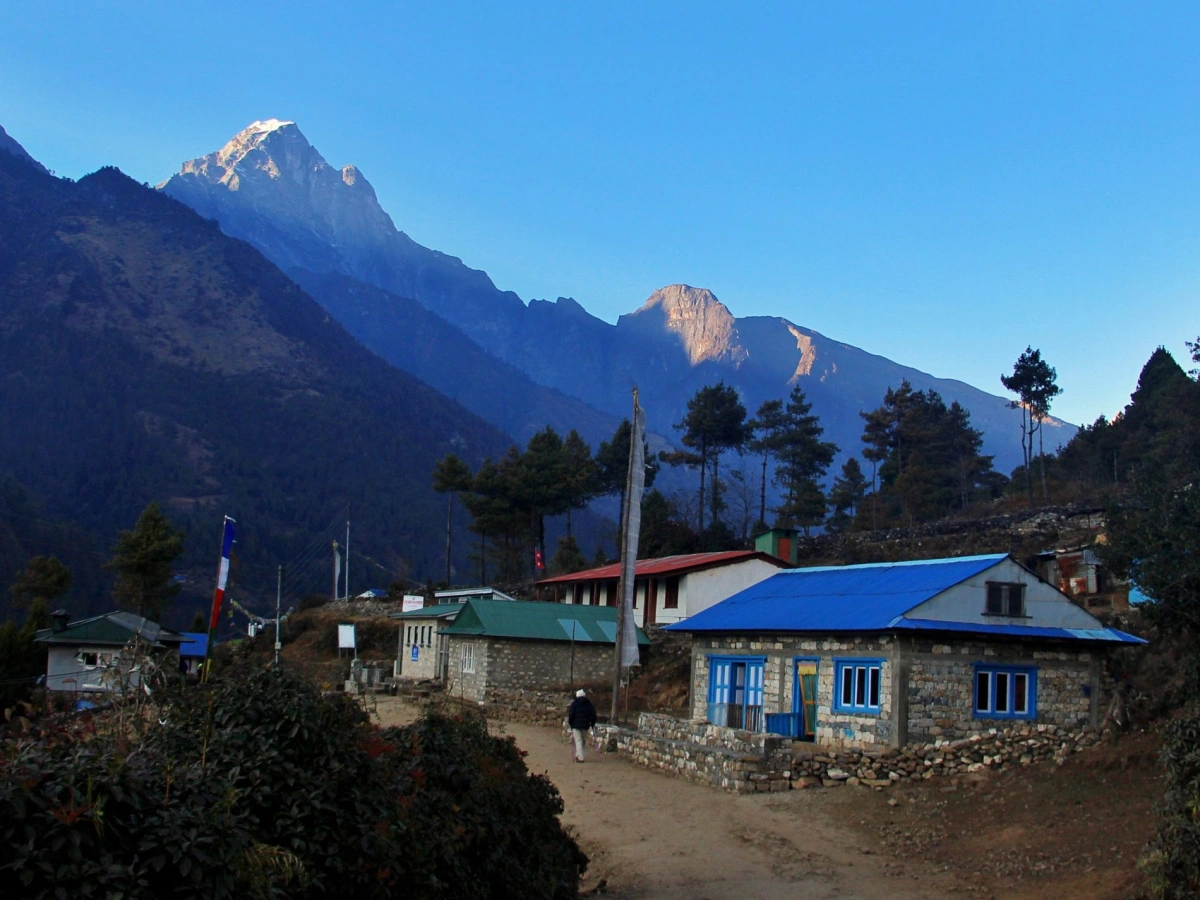
The 17-day Everest Base Camp Trek by Road is a premier, flight-free alternative designed for travelers seeking reliability and superior acclimatization. By replacing the unpredictable Lukla flight with a scenic 4WD jeep journey through the mid-hills of Nepal, this trek eliminates the stress of weather-related delays while offering a deeper look into rural Sherpa and Rai cultures. Starting from the lower trailhead at Thamdanda, you will ascend gradually through lush rhododendron forests and hidden villages before merging with the iconic Khumbu trail.

Duration
17 Days
Trip Grade
Moderate
Country
Nepal
Max Altitude
5,545m / 18,192ft. at Kala Patthar
Starts
Kathmandu
Ends
Kathmandu
Group Size
Flexible (Solo/Group)
Activities
Trekking & Hiking
Best Time
Mar-May & Sept - Dec

Starting with a scenic overland drive to the lower Solukhumbu region, the 17-day Everest Base Camp Trek by Road offers a safer, more immersive alternative to the classic flight-based route. You will drive through the beautiful mid-hills to Salleri and Thamdanda before trekking through pristine villages like Paiya and Surke, eventually merging with the main trail at Phakding. This route allows for exceptional acclimatization as you gradually ascend through Sagarmatha National Park, a UNESCO World Heritage Site.

The highlight of this trek is reaching the base of the world's highest peak, Mount Everest (8,848.86m), and hiking to Kala Patthar (5,545m) for a 360-degree sunrise view. From the summit, you are rewarded with panoramic views of Nuptse, Pumori, and Lhotse. Carefully planned with proper acclimatization days in Namche Bazaar and Dingboche, the 17-day itinerary is ideal for trekkers looking for a reliable, flight-free, and unforgettable Everest adventure for 2026/2027.

Why Go on the 17-day Everest Base Camp trek by Road?

For many hikers, the journey is just as important as the destination. That's exactly what the 17-day Everest Base Camp Trek by Road offers: a trip into the heart of the Khumbu that eliminates the stress of Lukla flights while combining breathtaking diverse landscapes, gradual altitude gain, and genuine cultural immersion.

Here are the top reasons to choose the Everest Base Camp Trek by Road:

No Flight Uncertainty: The most significant advantage is avoiding the overwhelming and often delayed Lukla flight. You travel by jeep to Thamdanda, ensuring a reliable departure and return regardless of weather conditions at the airport.

Superior Acclimatization: Unlike the flight which rushes you to 2,860m, this route starts lower and ascends gradually, significantly reducing the risk of altitude sickness. This makes it a safer option for trekkers of all ages.

Discover Hidden Villages: You will drive through remote, culturally intact villages like Salleri, Phaplu, and Kharikhola that most fly-in tourists never see. This offers a deeper connection to the Rai and Sherpa communities.

Diverse Landscapes: The drive and initial trek take you through changing terrains, from terraced fields and lush rhododendron forests in the lower hills to the stark alpine wilderness of the high Himalayas.

A Typical Day During the 17-day Everest Base Camp Trek by Road 2026/2027

A typical day on the 17-day Everest Base Camp Trek by Roadfollows a well-paced routine designed for comfort, safety, and proper acclimatization. Your day begins early, around 6:00 to 7:00 AM, to make the most of the clear morning weather. After waking up in your teahouse, you will enjoy a breakfast that you ordered.

After breakfast, you set out on the trail with your professional trekking guide. The walk takes you along scenic paths that change from lush forests to rugged mountain terrain. Around midday, you will stop for lunch at a trailside lodge. Evenings are spent relaxing in the communal dining area, where a warm fire is usually lit. This is a great time to chat with fellow trekkers or play cards. After dinner, your guide will brief you on the next day's route and elevation.

Costs of the 17-day Everest Base Camp Trek:

Permits, Guides, Porters, and Transport 2026/2027

The 17-day Everest Base Camp Trek by Road is a comprehensive package that offers excellent value by replacing expensive flights with cost-effective overland travel. Our package includes all essential logistics: private/shared jeep transportation, all trekking permits (Sagarmatha National Park and Local Municipality fees), experienced guides, full-board meals during the trek, and standard teahouse accommodation. Porter service is not incuded but can be arranged on a 1:2 ratio (one porter for two trekkers).

Major Highlights of the 17-day Everest Base Camp Trek by Road

  • Enjoy a beautiful journey through Nepal's mid-hills from Kathmandu to Salleri and Thamdanda.
  • Gain better natural acclimatization through a gradual ascent, lowering the risk of altitude sickness.
  • Trek through authentic, rarely visited villages like Paiya and Surke before joining the main trail.
  • Explore Namche Bazaar, Tengboche Monastery, and the impressive Khumbu Glacier.
  • Reach Everest Base Camp (5,364m) and stand at the foot of the world’s highest peak.
  • Climb to 5,545m for the most famous sunrise and panoramic views of Mt. Everest and Lhotse.
  • Eliminate the uncertainty of flight cancellations with a guaranteed road-based itinerary.
  • Experience deep immersion into the traditions, culture, and warmth of the Sherpa people.

Jeep Transport During the 17-day Everest Base Camp Trek by Road in Nepal

The road journey offers a look at rural Nepalese life that fly-in trekkers miss, passing rivers, terraced fields, and dense forests. While the road can be bumpy and dusty, especially the off-road sections after Salleri, it guarantees that your trip proceeds regardless of the cloudy weather. We use reliable 4WD jeeps with experienced drivers to navigate the mountain roads safely.

Booking & Customization of the 18-day Everest Base Camp Trek by Road 2026/2027

Nature Lovers Treks and Tours offers fully customizable packages. You may choose to upgrade to a private jeep, add extra acclimatization days, or even combine the trek with a helicopter return from Gorakshep to save time on the way back. Discuss your preferences with our experts to create the perfect itinerary.


Short Itinerary & Altitude

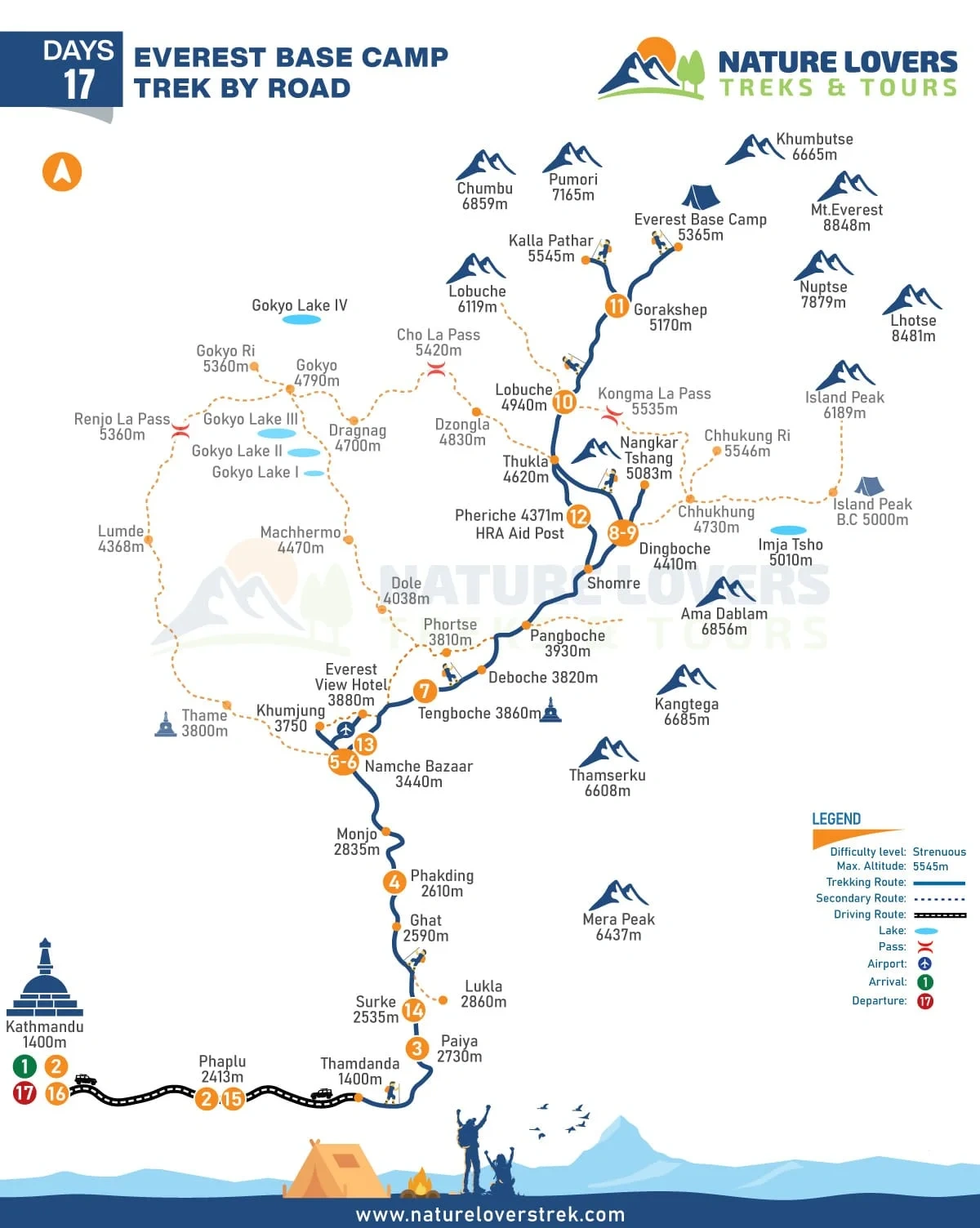
Everest Base Camp Trek by Road - 17 Days Detailed Itinerary

Day 1

Arrival in Kathmandu (1,324m) & transfer to Hotel

Upon your arrival at Tribhuvan International Airport, a company representative will greet you and transfer you to your hotel. The rest of the day is for resting or exploring the vibrant streets of Thamel. In the evening, we will hold a pre-trek meeting to check your gear and provide a detailed briefing of the upcoming adventure.

Day 2

Drive from Kathmandu to Salleri/Phaplu (2,413m)

The journey begins with a long, scenic drive departing early from Kathmandu. We travel along the BP Highway, following the Sun Koshi River and passing through numerous traditional hill towns. The road winds through terraced fields and lush forests, offering a glimpse into the rural lifestyle of Nepal before arriving at Salleri, the headquarters of the Solukhumbu district.

Day 3

Drive from Salleri to Thamdanda & trek to Paiya (2,730m)

We continue our journey with a rough, off-road jeep drive from Salleri to Thamdanda, which is currently the end of the road access. After reaching the trailhead, we begin our actual trek, walking for a few hours through beautiful landscapes and forests to reach the quiet village of Paiya (also known as Chutok), where we spend our first night in a mountain teahouse.

Day 4

Trek from Paiya to Phakding (2,610m)

The trail descends from Paiya towards Surke, passing through small settlements and crossing the Handi Khola. We walk past the village of Surke, located just below Lukla, and join the main trekking trail that comes from the Lukla airport. We continue through Chaurikharka and eventually reach the village of Phakding, situated alongside the turquoise Dudh Koshi River.

Day 5

Trek from Phakding to Namche Bazaar (3,440m)

Today’s trek takes us through several suspension bridges, including the famous Hillary Bridge. We enter the Sagarmatha National Park at Monjo, where permits are checked. The trail then involves a final, steep zig-zag climb through pine forests. As we ascend, we may catch our first glimpse of Mt. Everest before arriving at the bustling horseshoe-shaped town of Namche Bazaar.

Day 6

Acclimatization day in Namche | hike to Hotel Everest View (3,880m)

To help our bodies adjust to the altitude, we spend a day in Namche Bazaar. We take a steep hike up to the Everest View Hotel (3,880m) for a stunning panorama of Everest, Lhotse, and Ama Dablam. Later, we can visit the Sherpa Culture Museum or explore the local markets and bakeries that make Namche the heart of the Khumbu region.

Day 7

Trek from Namche Bazaar to Tengboche (3,860m)

The trail out of Namche offers spectacular views as it winds around the hillside. We descend to Phungi Thenga for lunch before making a steady climb through rhododendron forests to reach Tengboche. This village is home to the famous Tengboche Monastery, the largest in the region, where we can witness monks chanting against the backdrop of Ama Dablam.

Day 8

Trek from Tengboche to Dingboche (4,410m)

We descend through the forest to Deboche and cross the Imja Khola via a suspension bridge. The trail passes the ancient mani walls of Pangboche village, where the treeline begins to disappear. We enter the Imja Valley and ascend gradually to the summer settlement of Dingboche, which is surrounded by stone walls to protect crops from the wind.

Day 9

Acclimatization day in Dingboche | hike to Nangkartshang Peak (5,083m)

A second acclimatization day is vital before heading higher. Most trekkers opt for a hike up Nangkartshang Peak (5,083m) or towards the Chhukung Valley. These hikes offer incredible views of Makalu, Lhotse, and the north face of Ama Dablam. Spending time at this altitude helps ensure a successful and safe journey to the base camp.

Day 10

Trek from Dingboche to Lobuche (4,910m)

The trek continues upward onto the lateral moraine of the Khumbu Glacier. We stop at Thukla (Dughla) for a break before climbing the steep "Memorial Hill," where monuments are dedicated to climbers who lost their lives on Everest. The trail then levels out slightly as we reach the small settlement of Lobuche, tucked beneath the towering peaks.

Day 11

Trek from Lobuche to Gorakshep (5,140m) & hike to Everest Base Camp (5,364m)

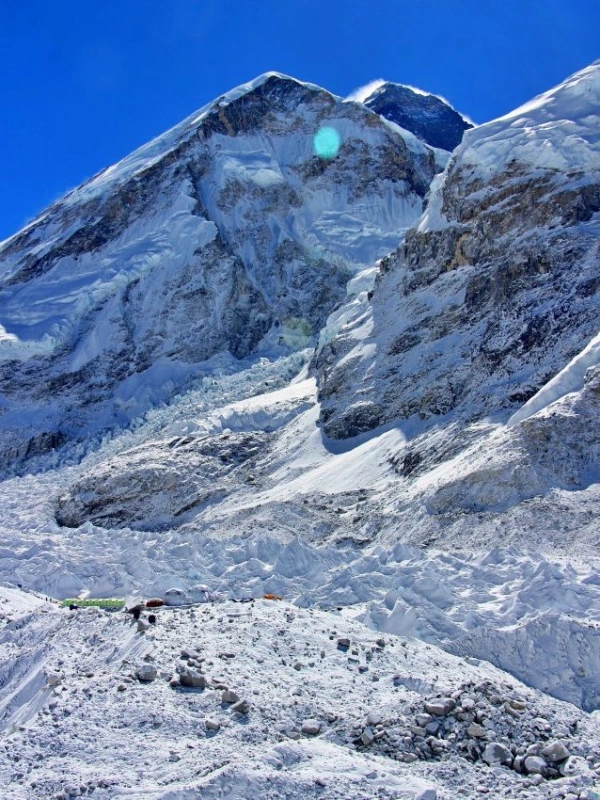
Today is the most anticipated day of the trek. We walk across rocky moraine to reach Gorakshep, the highest settlement. After a quick lunch, we push on to Everest Base Camp. Standing on the Khumbu Glacier, surrounded by prayer flags and the Khumbu Icefall, is an emotional highlight. After soaking in the atmosphere, we return to Gorakshep for a cold but rewarding night.

Day 12

Hike to Kala Patthar (5,545m) & trek back to Pheriche (4,240m)

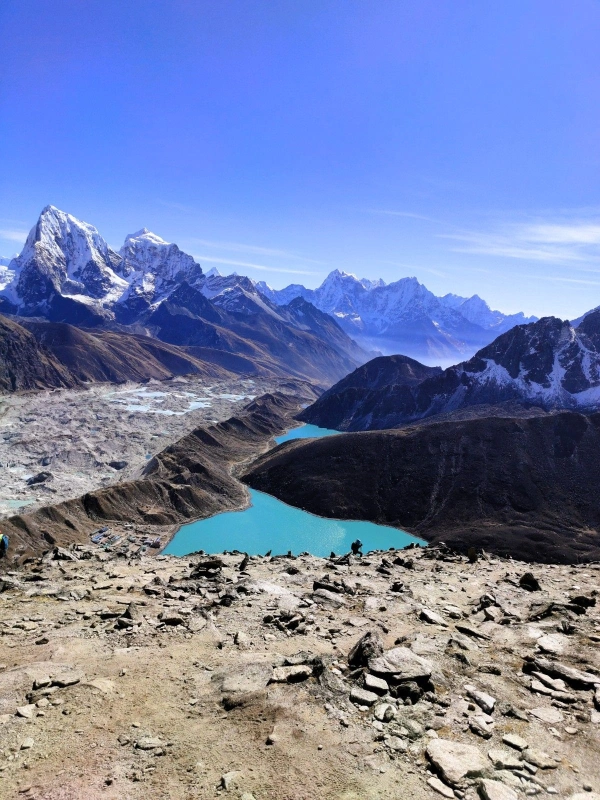
Before dawn, we begin a challenging climb to the summit of Kala Patthar (5,545m). This is the highest point of the trek and offers the ultimate 360-degree view of Everest, Nuptse, and the surrounding giants. We then descend to Gorakshep for breakfast and continue all the way down to Pheriche, where the higher oxygen levels make for a very comfortable night’s sleep.

Day 13

Trek from Pheriche to Namche Bazaar (3,440m)

The descent feels much easier as we lose altitude. We trek back through Pangboche and Tengboche, descending steeply to the river before climbing back up to the ridge. The path eventually leads us back to the familiar streets of Namche Bazaar, where you can enjoy a hot shower and celebrate your achievement with a "mountain latte" or a beer.

Day 14

Trek from Namche Bazaar to Chaurikharka/Surke (2,535m)

We bid farewell to the high mountains as we descend the steep hill out of Namche. Crossing the Hillary Bridge once more, we exit the National Park at Monjo. Instead of heading to the Lukla airport, we continue our trek toward Surke or Chaurikharka, enjoying the warmer air and lush greenery of the lower valley.

Day 15

Trek from Chaurikharka/Surke to Thamdanda and drive to Phaplu (2,413m)

Our final day of walking takes us back up to Thamdanda. It is a rewarding trek through the forest, marking the end of our journey on foot. At Thamdanda, our jeep awaits to take us on a scenic drive back to Salleri or Phaplu. We enjoy a final dinner with our trekking crew to celebrate the completion of the trek.

Day 16

Drive from Phaplu to Kathmandu (1,324m)

We start early for the 10 to 12-hour drive back to Kathmandu. The journey takes us through the winding roads of the mid-hills, providing one last look at the beautiful Nepalese countryside. Upon arrival in Kathmandu, we transfer you to your hotel for a well-deserved rest and a long-awaited hot shower.

Day 17

Final departure from Nepal

Your 17-day Everest adventure concludes today. Depending on your flight schedule, our representative will provide a transfer to the international airport. You head home with unforgettable memories of the world's highest peak and the beautiful people of the Khumbu.

Still Confused?
No worries. Our team is ready to guide you every step of the way.

Cost Details

Includes

  • Airport pick-up and drop-off service by private vehicle
  • 3 Nights Hotel Accommodation in Kathmandu on BB Basis 
  • Shared Jeep Drive from Kathmandu to Thamdanda and back (added cost for private jeep)
  • Sagarmatha National Park entry permit and Khumbu Pasang Lhamu local fee
  • Accommodations in standard mountain teahouses lodge during the trek
  • All meals (Breakfast, Lunch, Dinner) during the trek
  • Professional English-speaking government-licensed trekking guide
  • Porter service (1 porter for 2 trekkers) including their insurance and equipment
  • Sleeping bag and Duffle Bag (to be returned after the trek)
  • Nature Lovers Treks and Tours company t-shirt, trip route map, and certificate of achievement
  • First aid kit and Oximeter for safety monitoring
  • All government Taxes, VAT and service charge

Excludes

  • International airfare and Nepal entry visa
  • Travel insurance (mandatory, must cover emergency helicopter rescue)
  • Lunch and dinner in Kathmandu
  • Personal expenses (Wi-Fi, hot showers, battery charging, laundry)
  • Bottled water, alcoholic beverages, and soft drinks
  • Tips for the guide, porters (highly recommended)

Equipment Lists

Equipment & Packing List for the 17-day Everest Base Camp Trek by Road in Nepal 2026/2027

Head
+
  • Sun hat or cap
  • Headlamp with extra batteries
  • Sunglasses with UV protection
  • Woolen hat/beanie
  • Buff or neck gaiter 
Upper Body
+
  • Moisture-wicking T-shirts
  • Thermal base layers
  • Fleece jacket
  • Down jacket (essential above 3,000m)
  • Waterproof/Windproof shell jacket 
Hands
+
  • Inner gloves
  • Insulated gloves or mittens
Lower Body
+
  • Trekking pants (convertible preferred)
  • Thermal leggings
  • Waterproof pants 
Foot Wear
+
  • Sturdy trekking boots (broken-in)
  • Camp shoes/sandals
  • Wool/synthetic trekking socks 
Toiletries
+
  • Quick-dry towel
  • Sunscreen (SPF 50+) & Lip balm
  • Hand sanitizer & wet wipes
  • Water purification tablets 
Miscellaneous
+
  • Sleeping bag (rated -10°C to 0°C)
  • Daypack (35-45L)
  • Trekking poles
  • Power bank
  • Water bottles (2L capacity)
  • First aid kit & personal medication 

Essential Information

Best Time to Visit for the Road Route

Selecting the right season is crucial for the road-based itinerary. Spring (March to May) is a favorite for nature enthusiasts, as the lower trails from Thamdanda to Phakding are ablaze with blooming rhododendrons and magnolias, and temperatures are mild. Autumn (September to November) is widely considered the peak season; following the monsoon, the dust is settled, and the atmosphere is crystal clear, offering the sharpest views of Mt. Everest, Lhotse, and Ama Dablam. While Winter (December to February) offers quiet trails and crisp skies, the road to Salleri can become icy, and temperatures at Gorakshep drop well below -15°C. We generally advise against the Monsoon (June to August) for this specific package, as heavy rains can trigger landslides and make the long off-road jeep sections muddy and unpredictable.

Trek Difficulty and Physical Fitness

The 17-day journey is graded as a Moderate trek, but it requires high physical endurance due to its length. Unlike fly-in trekkers who start at 2,860m, you will be walking through the rolling hills of the lower Khumbu, which involves more "Nepali flats" (ascending and descending repeatedly). You should be prepared to hike for 6 to 8 hours daily on rocky, uneven terrain. While technical climbing skills are not required, mental resilience is key for the final push to Base Camp. The greatest advantage of this route is safety; the gradual overland approach provides a natural acclimatization window that makes the physical challenge much more manageable and safer than the rapid ascent of a flight-based itinerary.

Mountain Accommodation and Lodge Life

During your time in Kathmandu, you will enjoy the comfort of a 3-star hotel with modern amenities. Once on the trail, the accommodation shifts to traditional mountain teahouses. These are charming, family-run lodges where you will stay in twin-sharing rooms with simple wooden beds and foam mattresses. In lower hubs like Namche Bazaar and Dingboche, some lodges offer attached bathrooms and heated blankets for an extra fee. As you move into the high-altitude zones of Lobuche and Gorakshep, the facilities become more communal and basic. The heart of the lodge is the central dining hall, which is heated by a wood or yak-dung stove in the evenings, providing a warm space to socialize with fellow hikers from around the world.

Food, Nutrition, and Hydration

Our package includes full-board meals (breakfast, lunch, and dinner) to keep your energy levels consistent. The menus at the teahouses are surprisingly diverse, offering everything from the traditional Dal Bhat (lentil soup, rice, and vegetable curry) to international favorites like porridge, pancakes, pasta, and even yak steaks in lower regions. Because digestion slows down at high altitudes, we strongly recommend sticking to vegetarian options and avoiding meat above Namche Bazaar to prevent stomach upsets. For hydration, we discourage the use of plastic bottles; instead, bring a reusable bottle and use water purification tablets or a LifeStraw to treat the water provided at the lodges.

Who Is This Journey Best For?

This 17-day road adventure is specifically curated for risk-averse travelers who want to eliminate the anxiety of "the world's most dangerous airport" at Lukla. It is the perfect choice for those who have a few extra days to spare and want to see the "authentic Nepal" that exists outside the tourist hubs. If you enjoy scenic road trips, cultural immersion in quiet villages like Paiya and Surke, and want the highest possible success rate for reaching Base Camp through superior acclimatization, this is the package for you. It is suitable for fit beginners and veteran trekkers alike who appreciate a slower, more deliberate pace.

Internet, Electricity, and Connectivity

In the modern Khumbu, staying connected is possible but comes at a price. Most lodges utilize solar power or small hydro-plants, and they charge a fee of USD $2 to $5 to charge your phone, camera, or power bank. We highly recommend bringing a high-capacity power bank to save on costs. Regarding the internet, Wi-Fi is available in many lodges via "Everest Link" prepaid cards, but the signal can be slow and weather-dependent. For the best experience, we suggest purchasing a local Ncell or NTC SIM card in Kathmandu; you will find surprisingly good 4G/LTE coverage in Namche Bazaar, though the signal will likely disappear once you pass 4,000 meters.

Luggage, Porters, and Packing Ethics

To ensure a comfortable journey, we provide professional porters who are the backbone of the trek. Each porter can carry a maximum of 12 to 15 kg per trekker. Your gear should be packed in a durable duffel bag (which we provide). You will be responsible for carrying your own daypack (approx. 5–7 kg) containing your "essentials for the day," such as water, a rain jacket, sunblock, and valuables. We follow strict fair-treatment guidelines for our crew, ensuring they have proper insurance, clothing, and weight limits. We ask that you pack mindfully: heavy, unnecessary items only make the journey harder for your porter.

Nepal Visa and Entry Requirements

Entering Nepal is a straightforward process for most nationalities. You can obtain a Visa on Arrival at Tribhuvan International Airport in Kathmandu. You will need a passport with at least 6 months of validity and one blank page. The current visa fees are USD $30 for 15 days, $50 for 30 days, or $125 for 90 days. For a 17-day trek, we recommend the 30-day visa to provide a buffer for travel days. You can also apply online in advance via the official Department of Immigration website to skip the long queues at the airport kiosks.

You May Also Like

Need Help? Call Us+977 9851254172